In the product
Where compliance lives in the app
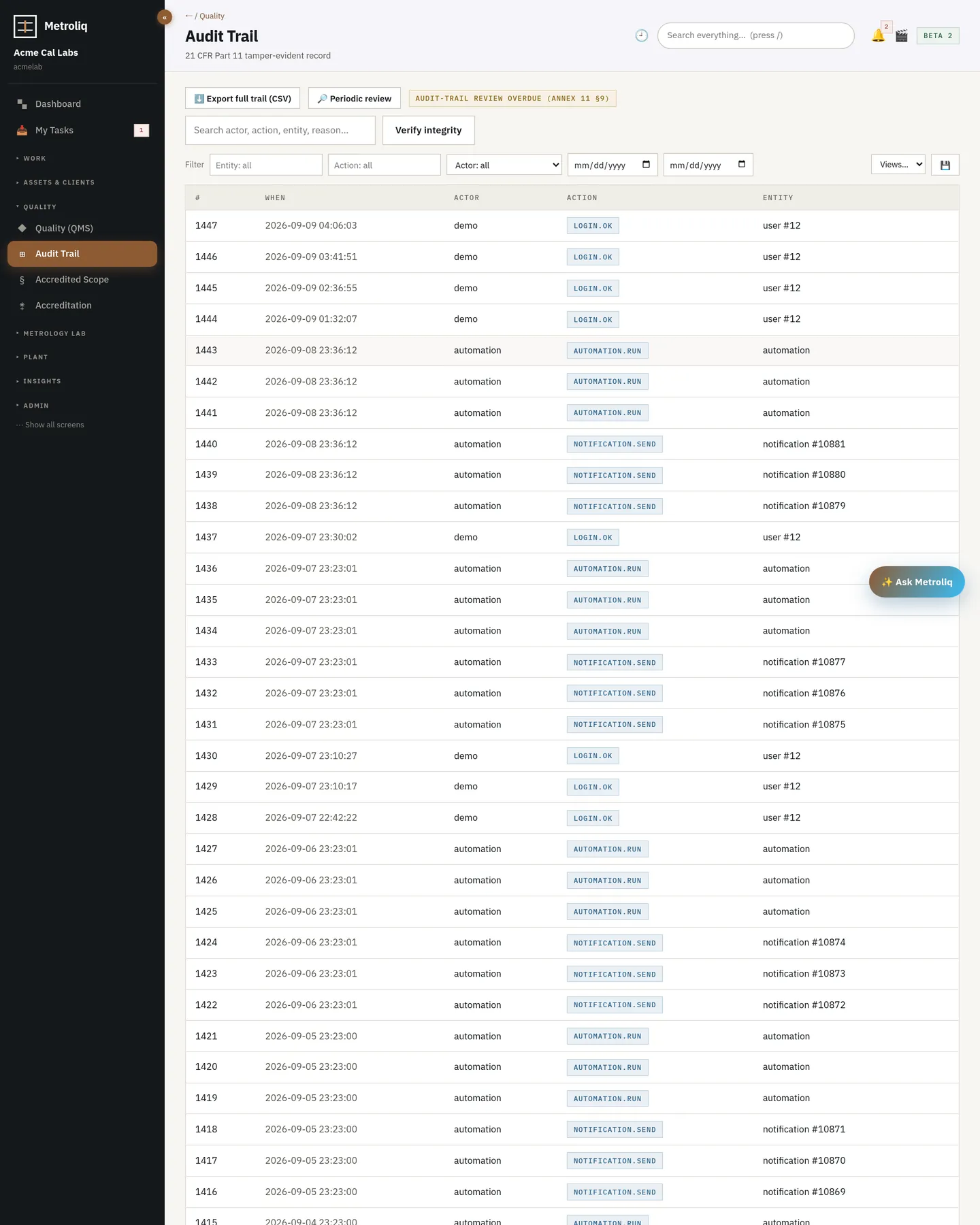
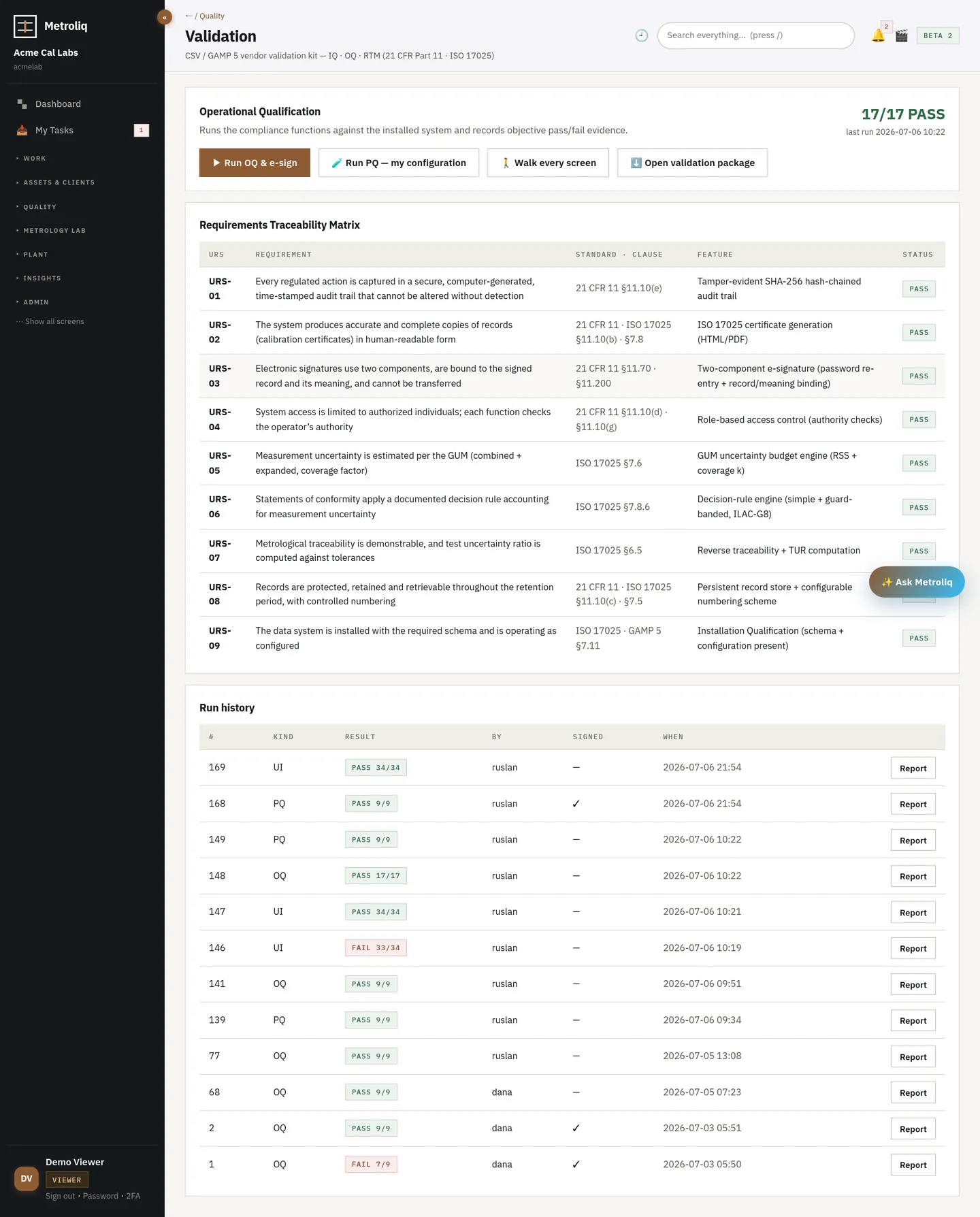
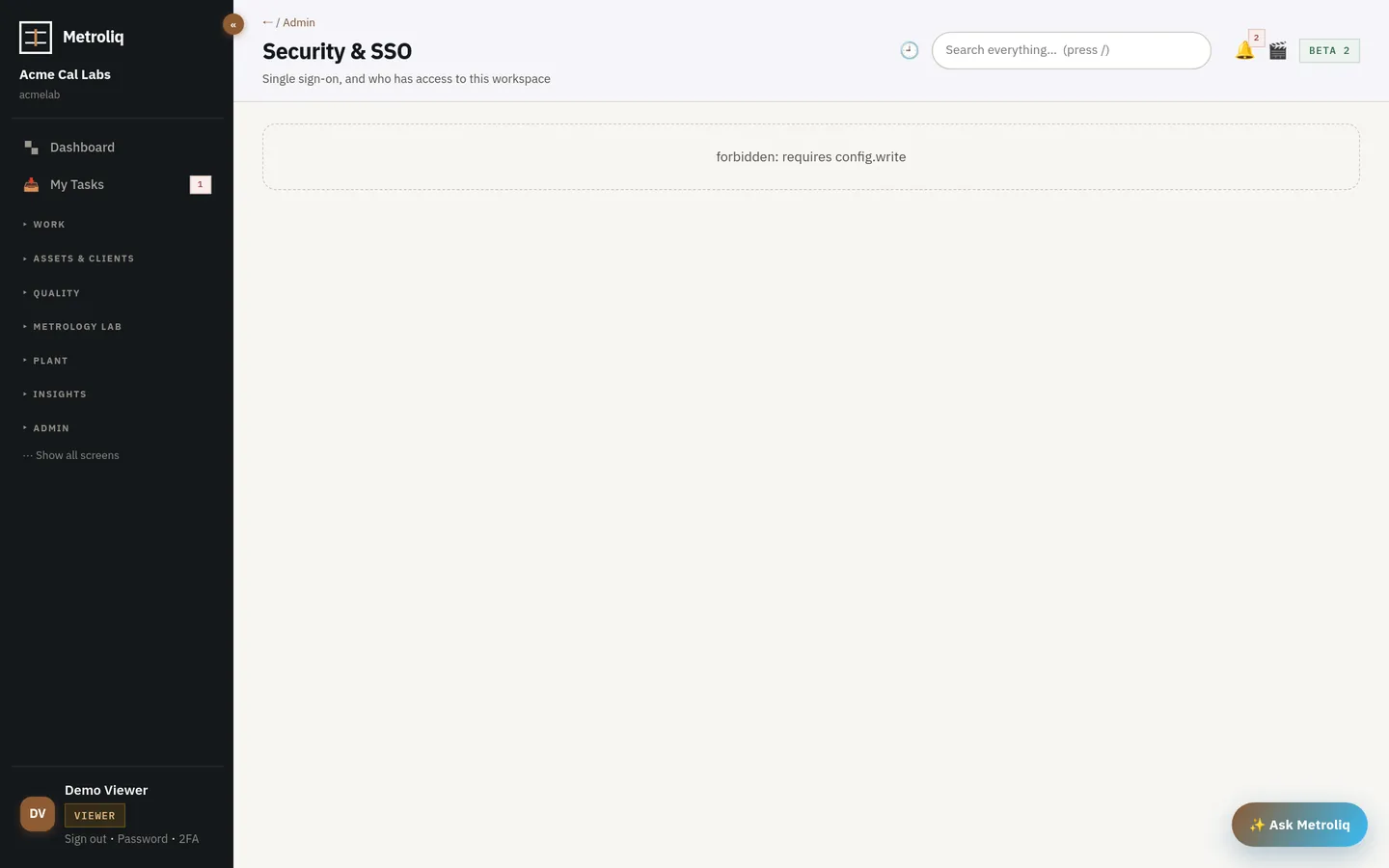
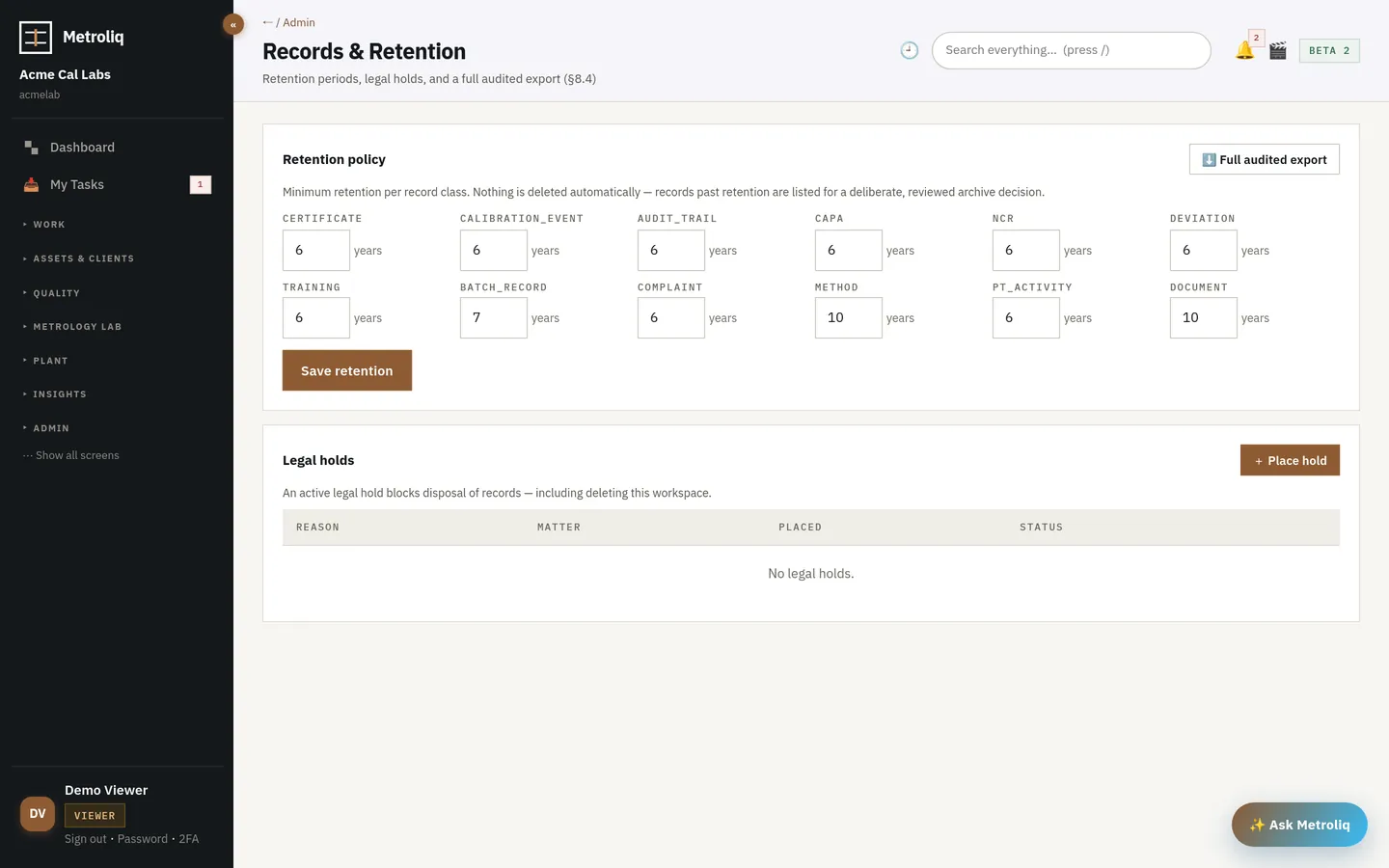
Metroliq does not have a compliance module. Compliance is how the record works: the hash-chained audit trail, two-component signatures bound to meaning, computed verdicts, amend-only certificates and supplier verification that runs itself.
This page maps the clauses labs and regulated plants are assessed against to the mechanisms in the platform. Every mapping points at a module page where the screens and capabilities are shown. Nothing here is a roadmap item.
Competence of testing and calibration laboratories. Authorization per discipline (§6.2.5), equipment and traceability (§6.4, §6.5), uncertainty (§7.6), decision rules (§7.8.6), reporting (§7.8), amendments (§7.8.8), nonconforming work, CAPA, internal audit, management review.
Electronic records and electronic signatures. Validation, accurate copies, retention, access control, secure time-stamped audit trails, operational sequencing, authority checks, two-component signatures, signature/record linking, password controls.
Computerised systems: validation, data storage, audit trails, security, electronic signatures, archiving — the European counterpart to Part 11 for pharmaceutical manufacturers.
Control of monitoring and measuring equipment, control of records, CAPA and management review for medical-device and general quality systems.
How uncertainty is reported on certificates (two significant figures, coverage factor and probability), how conformity is decided with guard bands, and how calibration intervals are reviewed from evidence.
Uncertainty propagation, Monte Carlo evaluation, conformity assessment risk (PFA/PFR), and the ANSI/NCSL Z540.3 false-accept target.
The PTB-led XML schema for machine-readable certificates with D-SI units, coverage factor and probability, influence conditions and conformity.
Attributable, legible, contemporaneous, original, accurate, complete, consistent, enduring, available — the data-integrity expectations regulators apply to every record.
Filter by standard or search a word. Each row names the requirement, the mechanism that meets it in the platform, and the module page where you can see it.
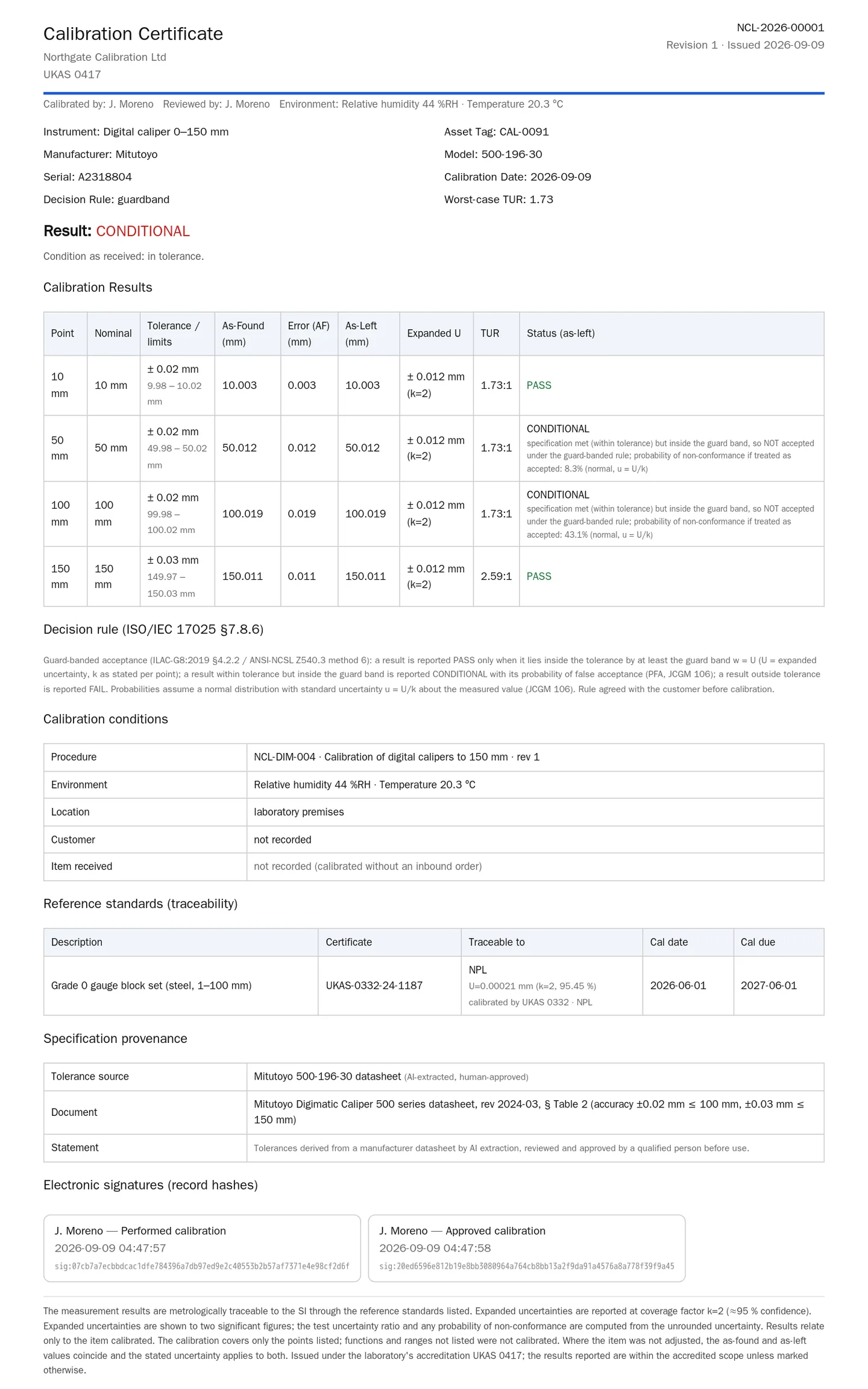
An annotated certificate as the platform prints it. Every block maps to the clause that requires it and the module that produces it. Download a real sample below in all three formats.
The audit trail is a SHA-256 hash chain over canonically serialised entries. This demo computes real hashes in your browser: change any detail and every later entry stops matching its stored hash.
A signature re-enters the password. A signing session of up to thirty minutes can be configured; zero means a password for every act.
Performed, approved, reviewed, released — the meaning is part of the signature and prints with the name and the timestamp.
Edit a signed record and the signatures are rescinded, visibly, with an audit entry saying so.
When the policy is on, the person who performed cannot approve; the API refuses it.
Every AI output is a draft in the provenance ledger until a qualified person signs it.
Answer honestly. The score is yours; the list underneath says which module closes each gap.
The tour runs the working platform, not a mockup. Pilot on your own instruments with your own imported history — we set it up with you, and fixes ship in hours and days, not release cycles.