metroliq
CalibrationCertificates & DCCQuality (QMS)Documents & trainingInstruments & captureSchedulingMaintenance (CMMS)Assets (EAM)Manufacturing (MES)Field serviceParts & inventoryService pipelineCustomer portalAI buildersIntegrations & APIComplianceWorkspace & admin
Quality management · QMS

A deviation the system can explain.

CAPA, NCR, deviations, complaints, controlled documents, training, audits, risks, change control, vendors, methods, proficiency testing — one records framework with real numbering, a status machine, versioning and e-signature gates. Change control now runs impact assessment through to an e-signed notification package, supplier qualification and SCARs run through an isolated supplier portal, and a medical-device pack adds design history, ISO 14971 risk and complaint reportability.

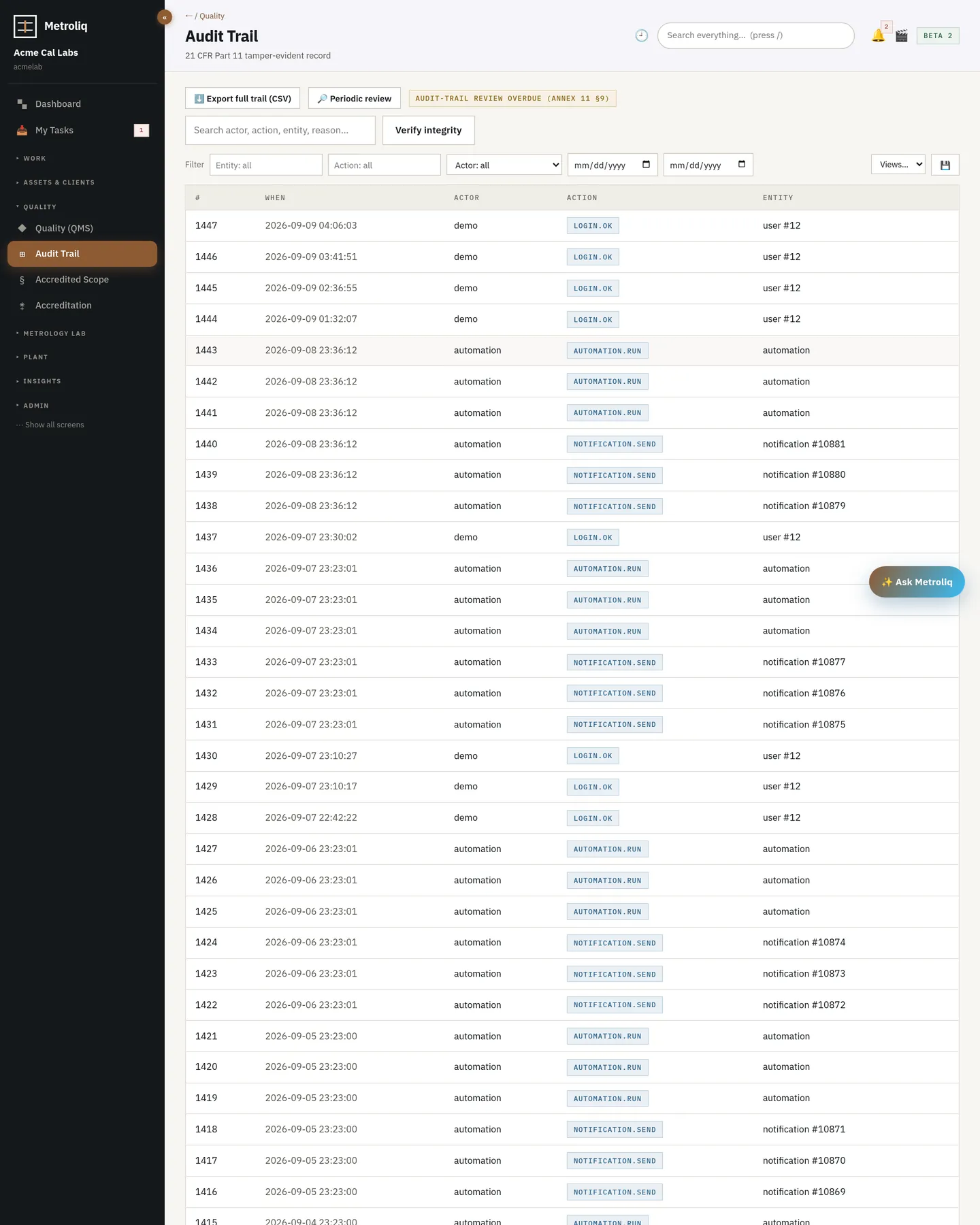
Every quality entity is a first-class record on the same audit trail as the calibration or work order it came from. Escalation carries the asset and the customer forward. Effectiveness is a record with a due date and evidence, not a checkbox. Editing a signed record rescinds the signatures and says so.

See it in the tour Every capability
ChainNCR → CAPA → effectiveness → close
Record types18
Signatures21 CFR Part 11
Management reviewAI-drafted §8.9
In the product

What it looks like

Screens from the live platform, demo tenant. Click any screen to open it full size.
Quality management board with open CAPAs, NCRs and deviations
The quality board: open records by type and status, what is due, and what is waiting on a signature.
How it works

From the first record to the signed result

  1. 01
    Raise

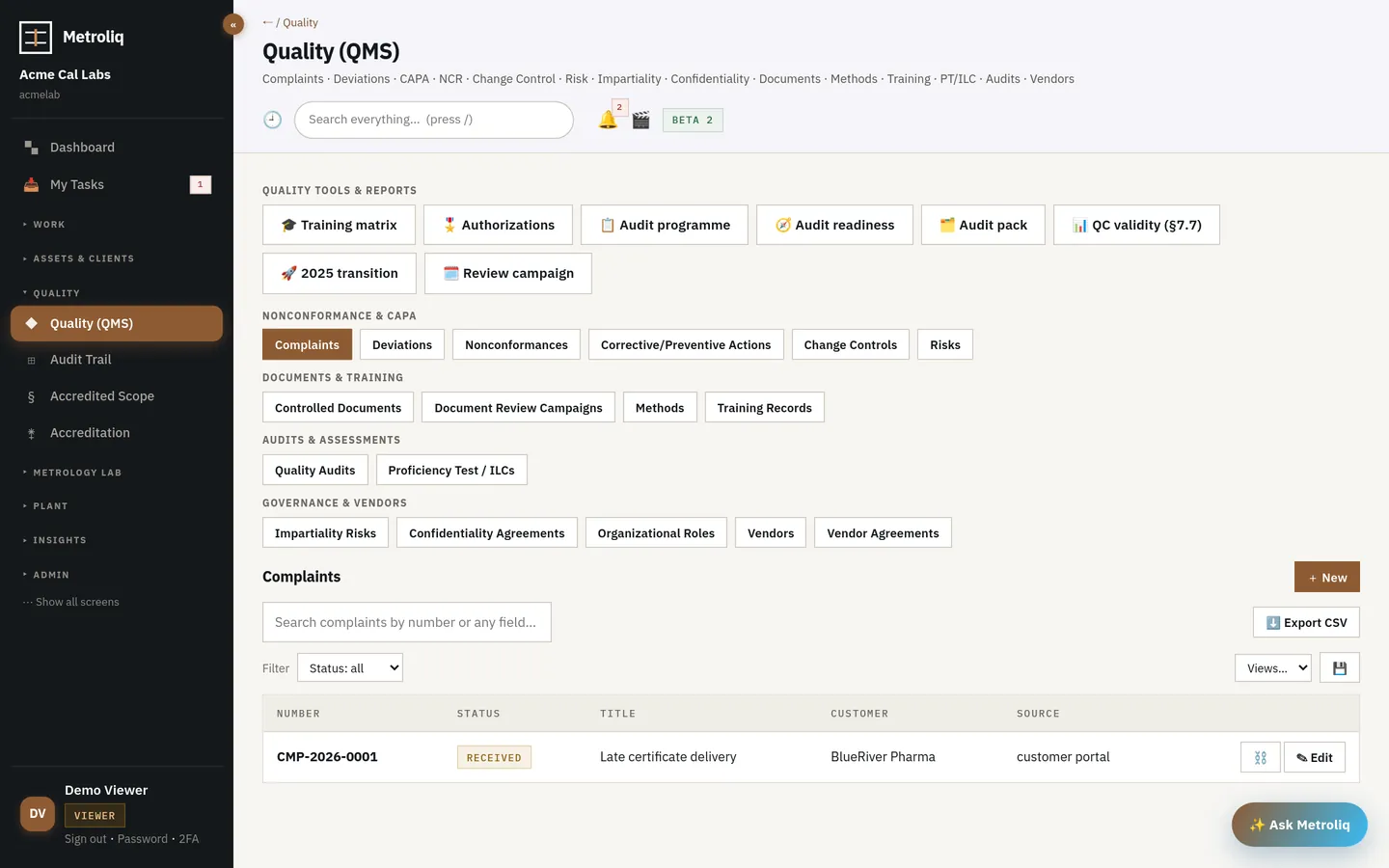
    An NCR, deviation or complaint is raised where the problem is — at the bench with the failing point attached, on the line from a batch step, from the portal by the customer.

  2. 02
    Investigate

    Root cause on the record. For an out-of-tolerance result the AI drafts the investigation grounded in reverse traceability: what did this instrument measure?

  3. 03
    Escalate

    One click to CAPA. The source records which CAPA it became and when; the CAPA records its sources. Asset and customer travel with it.

  4. 04
    Act

    Corrective and preventive actions with owners and dates. AI drafts; a named person owns and signs.

  5. 05
    Verify effectiveness

    A due date and evidence are required before closure. The effectiveness board shows what is due and overdue.

  6. 06
    Close and review

    Closure annotates the sources. Analytics feed an AI-drafted management review saved as a controlled document draft.

What it includes · 37 capabilities

Everything in the module

Records framework

  • CAPA, NCR, deviation, complaint, controlled document, training, audit event, audit programme, risk register, change control, vendor and vendor agreement, method register, org roles and deputies, impartiality risk, confidentiality agreement, proficiency testing / ILC, document review campaign
  • Real numbering per type, status machine, versioning, e-signature gates per transition
  • Unknown fields on a quality record are rejected, not silently dropped
  • Editing content in a signed state rescinds the signatures and audits the fact
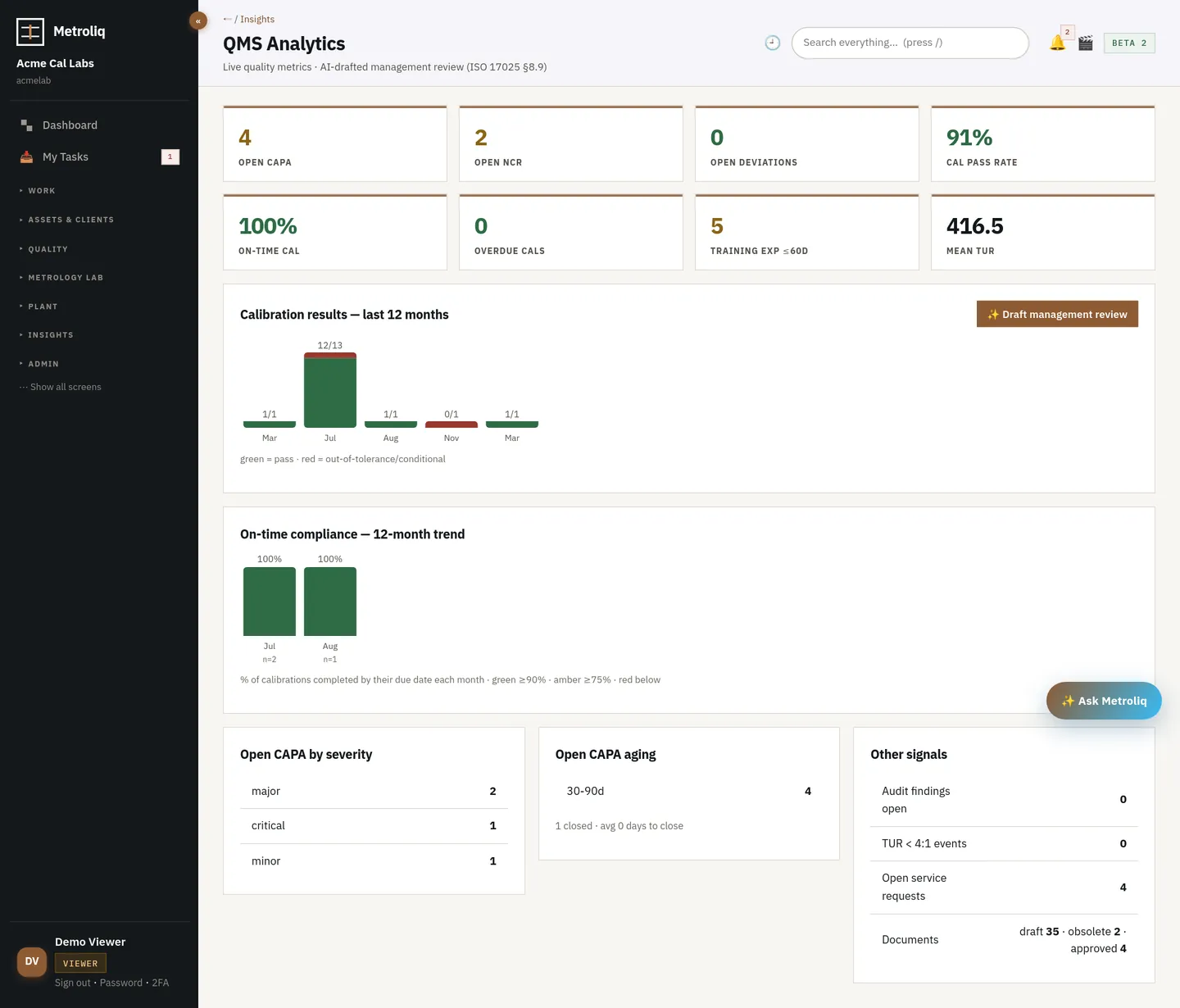
QMS analytics with CAPA effectiveness and trend charts
QMS analytics: CAPA effectiveness, overdue records, trends by cause — the inputs to management review.

CAPA and nonconformance

  • Escalation NCR / deviation / complaint → CAPA carrying asset and customer forward, linked both ways
  • CAPA effectiveness checks with a due / overdue effectiveness board
  • Out-of-tolerance impact review queue and clearance; recall impact walked across everything the instrument measured
  • AI-drafted investigation and CAPA (five-whys, containment, correction) recorded in the provenance ledger
  • One-step transition matrix on NCR, deviation, CAPA, complaint and change control — no jumping from open to closed
  • Closure gates: NCR needs a disposition, deviation a root cause and disposition, complaint an investigation and response
  • Effectiveness checks are e-signed; a closed CAPA cannot receive a new check without reopening
  • An NCR already escalated to an open CAPA cannot be escalated twice
  • Audit entries carry the before and after value of every changed field
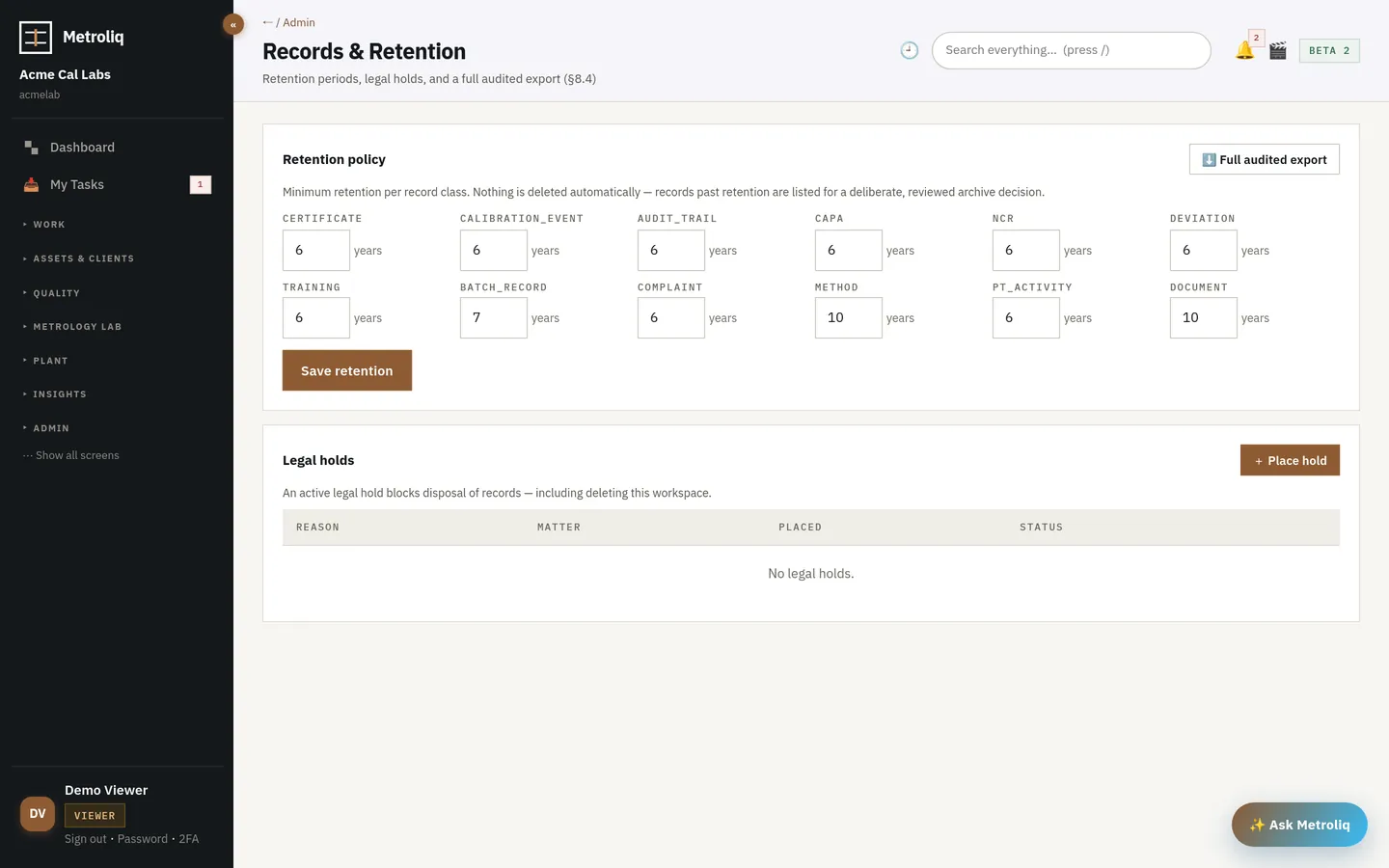
Records lifecycle with retention policies and legal holds
Records lifecycle: retention per class, legal holds, audited export. Nothing auto-deletes.

Documents and training

  • Controlled documents with named approvers, versioning, periodic review and review campaigns
  • Controlled-copy print; obsolescence cancels assigned training
  • Training with AI-drafted comprehension quizzes, attempts, acknowledgement and a training matrix
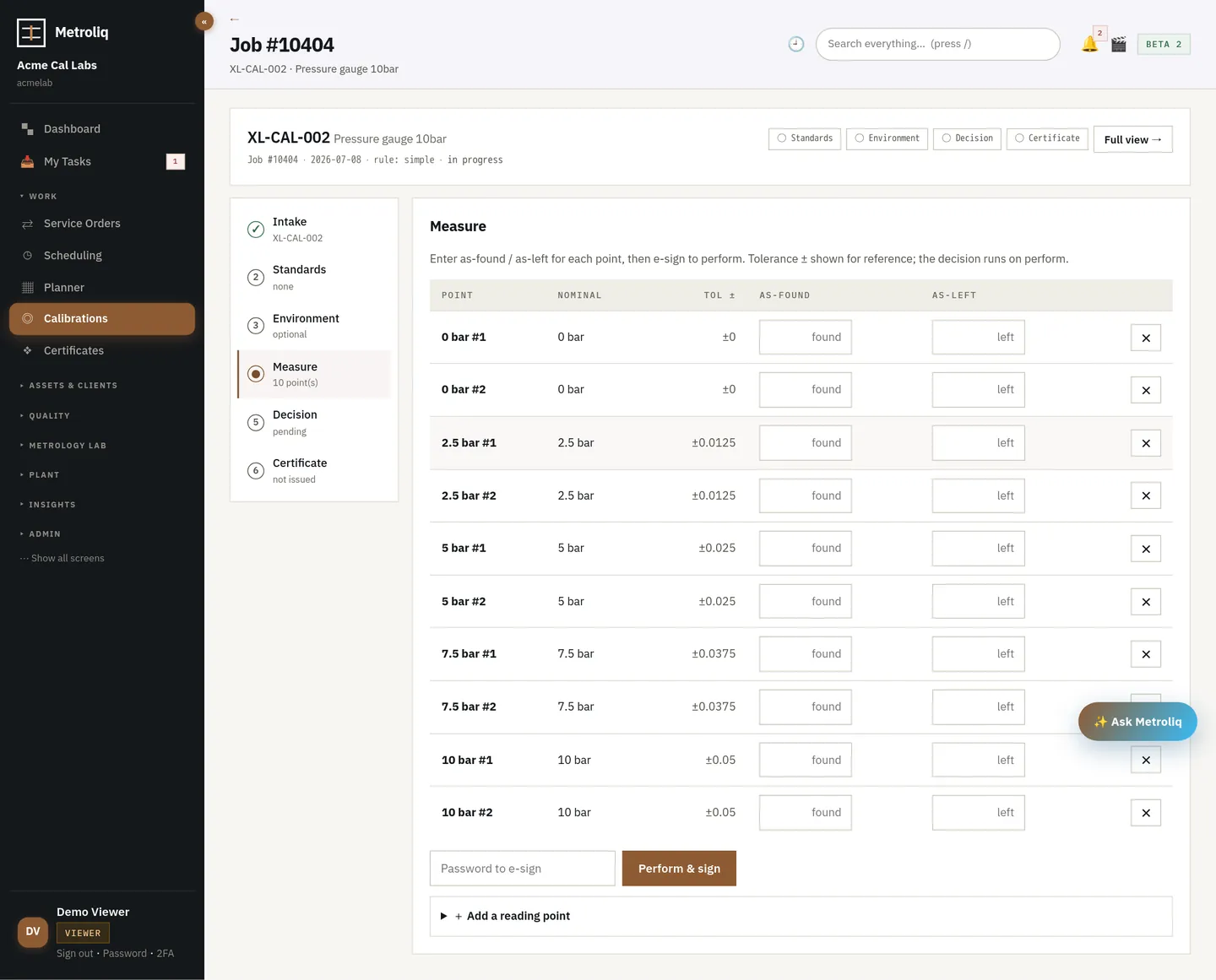
  • Technician authorization per discipline (§6.2.5) can be required before performing
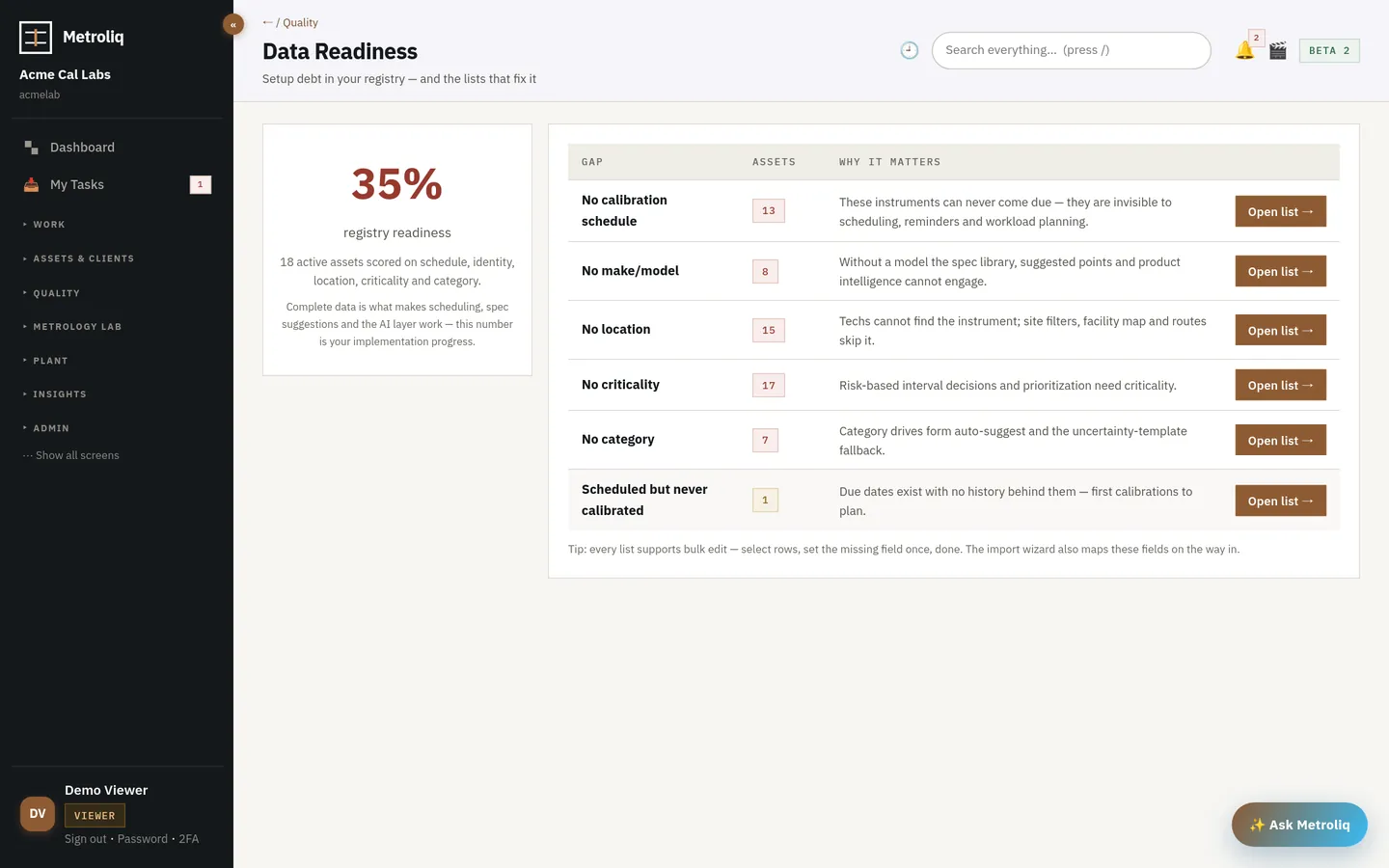
Audit readiness self-check with findings
Audit readiness self-check: what an assessor will ask for, and what is missing.

Audits, accreditation and risk

  • Audit programme, audit readiness self-check, assessment-pack export, transition pack
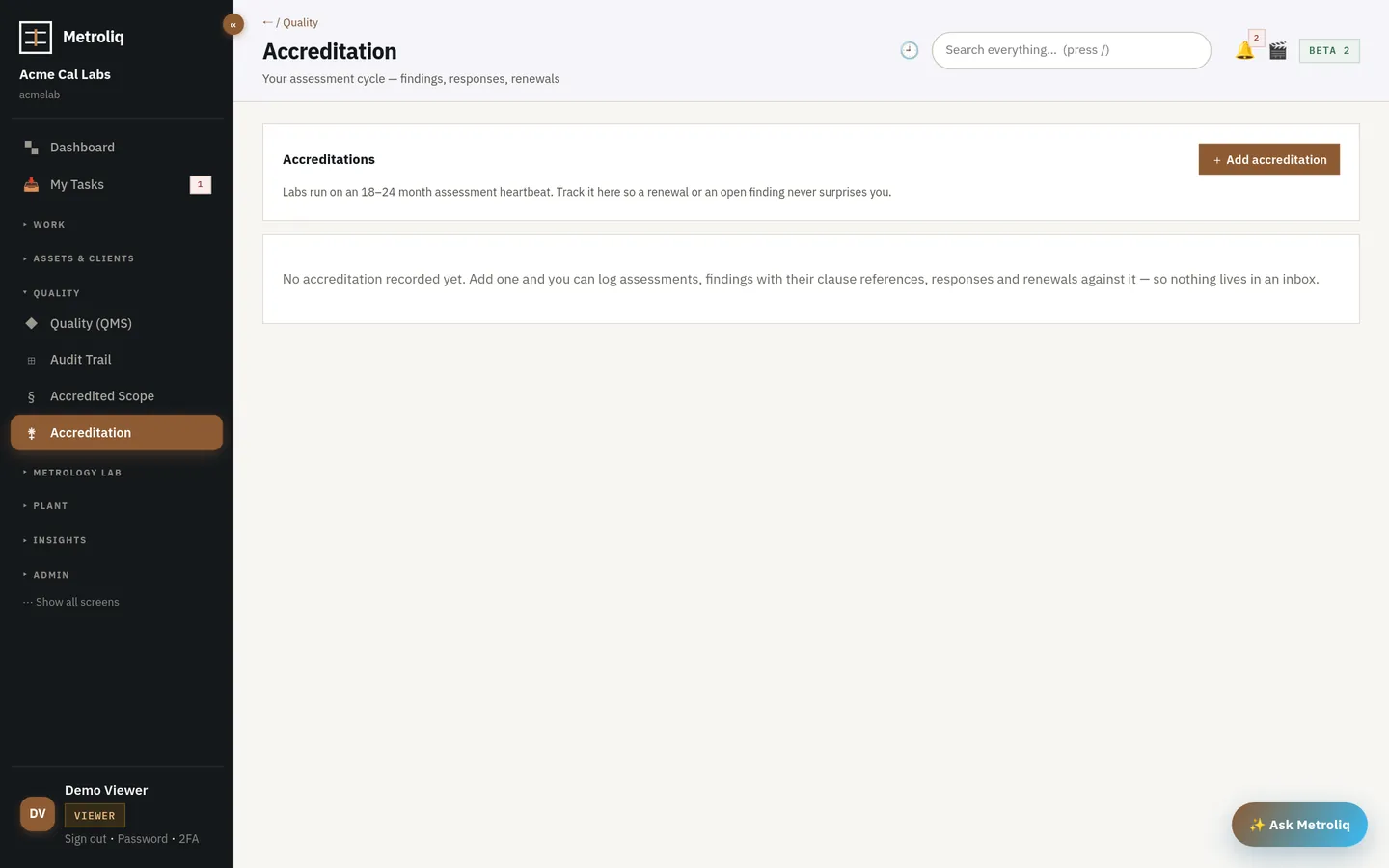
  • Accreditation lifecycle: assessments, findings, responses, renewals; accredited scope and CMC lines authoritative at perform
  • FMEA on risks, PT/ILC evaluation with En and z scores, method validation, vendor scorecards
  • QMS analytics, QC report, technician analytics, AI-drafted ISO §8.9 management review as a controlled document draft
Quality management board with open CAPAs, NCRs and deviations
The quality board: open records by type and status, what is due, and what is waiting on a signature.

Change-control impact

  • Automated impact discovery: a change's description, affected items and record links surface the documents, training, work instructions, methods, recipes, in-process batches, equipment, suppliers and customers it touches, for the assessor to confirm
  • Optional AI-drafted impact assessment with reasons per candidate; always a draft the assessor applies, never auto-saved
  • One implementation task per confirmed impact; e-signed completion for revalidation and requalification work; e-signed, reason-required waivers
  • Server-enforced gates (assessment complete, tasks resolved, effectiveness verified, package issued) apply identically to the guided UI and to direct API calls
  • One-click notification package PDF with impacts, tasks and evidence, signatures and distribution list, plus a release notification to every affected trainee and task owner
  • A Change Control Board shows every change by state with overdue-task counts
QMS analytics with CAPA effectiveness and trend charts
QMS analytics: CAPA effectiveness, overdue records, trends by cause — the inputs to management review.

Medical-device quality

  • Design history file with a live traceability matrix: every user need → input → output → V&V link tracked, gaps surfaced automatically, transfer blocked until the matrix is clean and every design review is e-signed closed
  • ISO 14971 hazard analysis with a per-tenant configurable severity × probability matrix, residual-risk re-evaluation and a generated Risk Management File PDF
  • Complaint reportability assessment (suggestion only, never auto-final) with FDA 30/5-day and EU MDR 15/10/2-day deadline clocks, plus FDA eMDR (XML/JSON) and EU MIR (JSON) export; submission stays manual, tracked by status and acknowledgement reference
  • Annual Product Quality Review assembled from real batch, deviation, complaint, CAPA, change-control and calibration-OOT data, with editable conclusions and e-signed sign-off
  • DMR index and DHF export tie approved documents and change controls to the design record
Records lifecycle with retention policies and legal holds
Records lifecycle: retention per class, legal holds, audited export. Nothing auto-deletes.

Supplier quality

  • Approved-supplier lifecycle: qualify vendors per category (calibration, parts, software, service) with risk rating and requalification date; purchase orders to a non-qualified vendor are blocked or warned by policy
  • Supplier corrective action requests: issue → supplier response → review → verification → e-signed close, with a mandatory verification note
  • A separate supplier portal with its own login and session, isolated from every lab route, where vendors answer SCARs with evidence, complete qualification questionnaires and upload certificates with expiry tracking
  • Incoming inspection against purchase orders: a rejection opens an NCR and optionally a SCAR, linked to the vendor
  • Live supplier scorecard from on-time delivery, incoming reject rate, SCAR count and response time
QMS analytics with CAPA effectiveness and trend charts
In the product QMS analytics: CAPA effectiveness, overdue records, trends by cause — the inputs to management review.
Guards the system enforces

Things it refuses to do

A quality system is defined as much by what it will not accept. These are enforced in the platform, not in a procedure.

refuses

Close a CAPA without verification

CAPA closure and a method's in-use status require a verification record.

refuses

Close proficiency testing on an unsatisfactory result

Follow-up text is required.

refuses

Release a batch with an open deviation

A batch record cannot release while a linked NCR or deviation is open.

refuses

Approve a routed record without its signatures

Routed entities need the routing signature set before they can be approved; a failed e-signature is recorded as such.

Watch

Quality management (QMS) in under a minute

CAPA, NCR, deviations, complaints, controlled documents, training, audits, risks, change control, vendors, methods, proficiency testing — one records framework with real numbering, a status machine, versioning and e-signature gates. Change control now runs impact assessment through to an e-signed notification package, supplier qualification and SCARs run through an isolated supplier portal, and a medical-device pack adds design history, ISO 14971 risk and complaint reportability.

Try it · The quality chain

NCR to CAPA to effectiveness, step by step.

Click through the chain to see what the record carries at each stage and what the system requires before it moves on.

Records lifecycle with retention policies and legal holds
In the product Records lifecycle: retention per class, legal holds, audited export. Nothing auto-deletes.
Why it's different

Compared with what is out there

Gauges

Quality-first suites don't know what a gauge is.

A nonconformance here is attached to the failing point, the instrument, the standard used and the customer — because the QMS and the calibration share a record.

CAPA

Calibration-first tools don't have a CAPA.

They store the failure and leave the investigation to another system. Here the investigation, the CAPA and the effectiveness check are on the same audit trail as the failure.

Evidence

Effectiveness is a record, not a checkbox.

Date, evidence, result. An auditor can open it. A CAPA cannot close without it.
Beta · free while we build it with the first labs and plants

Bring one lab and your real history.

The tour runs the working platform, not a mockup. Pilot on your own instruments with your own imported history — we set it up with you, and fixes ship in hours and days, not release cycles.