metroliq
CalibrationCertificates & DCCQuality (QMS)Documents & trainingInstruments & captureSchedulingMaintenance (CMMS)Assets (EAM)Manufacturing (MES)Field serviceParts & inventoryService pipelineCustomer portalAI buildersIntegrations & APIComplianceWorkspace & admin
Calibration & uncertainty

The verdict is computed, not typed.

Every calibration is a numbered event that carries its own points, readings, reference standards, environment and decision rule — and evaluates conformity live, with a full GUM budget per point. Metrology Lab tooling adds ITS-90 SPRT and thermocouple reference functions, loop and process calibration with hysteresis, the full AIAG MSA-4 suite and NCSLI RP-1 / ILAC-G24 interval analysis, all e-signed onto the asset. A barcode/QR scan gate on perform, standard selection, receiving and crib custody, plus a WYSIWYG label designer with PDF/ZPL output, keep physical identity tied to the record.

Tolerance bands resolve from typed specification formulas (percent of reading, percent of range, ppm, counts, range min/max). Uncertainty is evaluated per point from the contributors you declare, sensitivity coefficients are derived from the stated measurement equation, and the verdict is a closed set — PASS, CONDITIONAL, FAIL, INDETERMINATE — under the decision rule the job names. Approval is a separate, e-signed act by a second person if your policy says so. Ten instrument-family content packs install a measurement form, uncertainty budget and procedure in one step, and migration importers bring Fluke MET/TEAM, IndySoft, Beamex CMX and Qualer history across with a dry-run reconciliation.

See it in the tour Every capability
Verdict statesPASS · CONDITIONAL · FAIL · INDETERMINATE
Decision rules4
Monte Carlo trials10 k – 2 M
Coveragek from t-table
In the product

What it looks like

Screens from the live platform, demo tenant. Click any screen to open it full size.
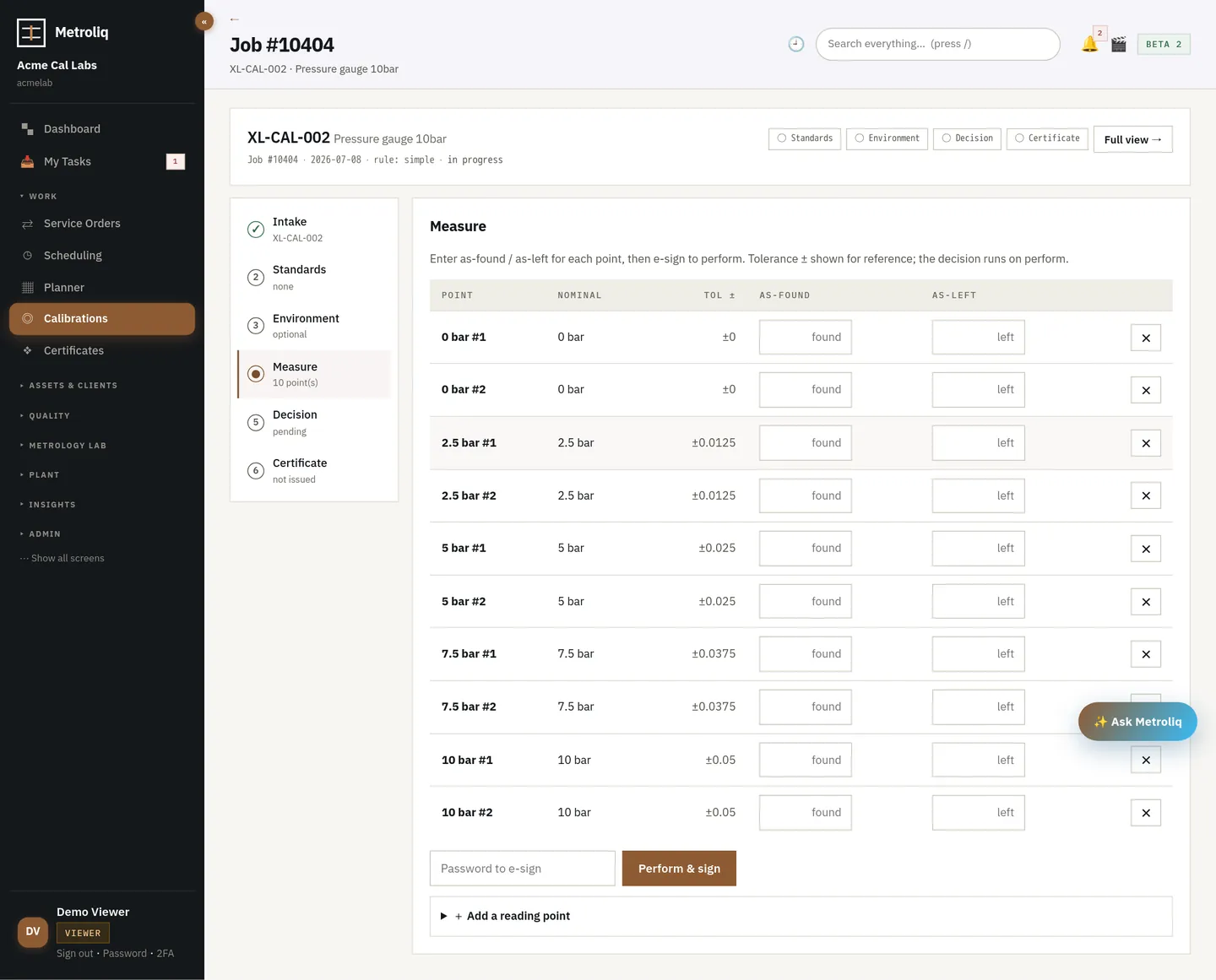
Guided job workspace with points, readings and live TUR and decision columns
The job workspace: points, as-found/as-left readings, and the TUR and decision computed as the reading is entered.
How it works

From draft to approved, with the maths in between

  1. 01
    Open the event

    An asset, a measurement form, a decision rule. Points and tolerances come from the typed specification; nothing is retyped.

  2. 02
    Pick the standards

    Reference standards are chosen for the job. Their calibration validity is checked; an overdue standard cannot be used.

  3. 03
    Record the environment

    Temperature, humidity, pressure — checked against the lab's limits and locked once the event is approved.

  4. 04
    Take the readings

    By hand or hands-free from the instrument. Each reading is evaluated against its tolerance and guard band as it lands.

  5. 05
    Evaluate the uncertainty

    A GUM budget per point: contributors reduced by their divisors, combined in quadrature, Welch–Satterthwaite degrees of freedom, k from the t-table. Sensitivity coefficients derived from the equation and cross-checked numerically.

  6. 06
    Decide

    Simple acceptance, guard-banded accept, guard-banded reject or a PFA target. Specific-risk PFA/PFR and conformance probability are computed and printed.

  7. 07
    Sign and approve

    Performed and approved are two signatures. With independent approval on, the performer cannot approve their own work.

What it includes · 39 capabilities

What the metrology engine does

Every item below is in the product today. Route and function names are the evidence, if you want to look.

Events and readings

  • Event lifecycle draft → performed → approved, with reject-to-draft, void and recompute
  • Points and readings with as-found and as-left, per point
  • Per-point uncertainty contributors
  • Reference standards and environment as signed parts of the record; environment locked after approval
  • Sequence and aggregate point kinds, including balance departure quads with run-consistency checks
  • Guided bench job workspace with stage jumps: standards, environment, measure, decision
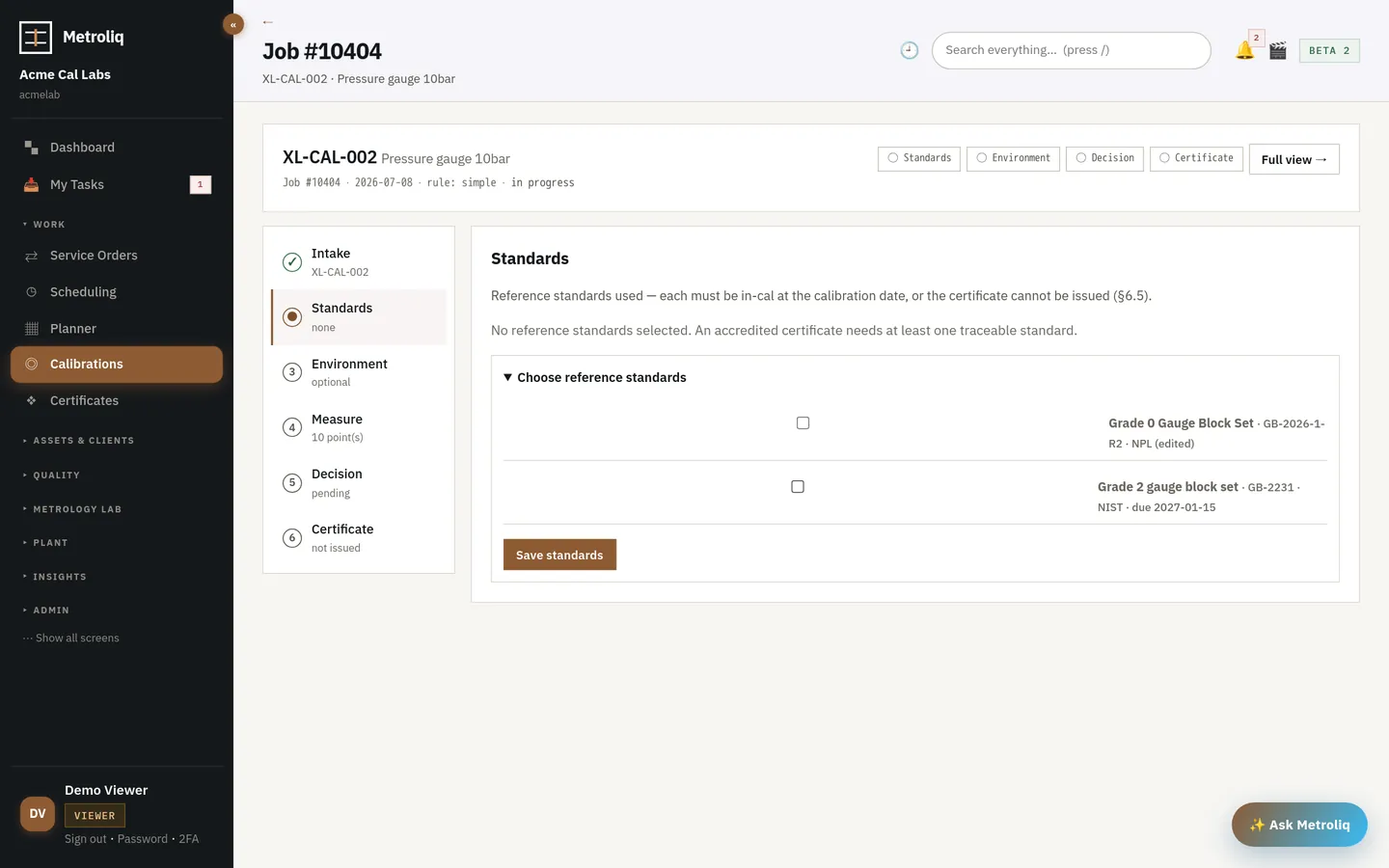
Choosing reference standards for a calibration with validity checks
Reference standards are chosen per job; an overdue standard is refused, and the choice is part of the signed record.

Uncertainty (GUM / JCGM 100, 101)

  • Standard uncertainty per distribution: normal, rectangular, triangular, U-shaped, Type A
  • Welch–Satterthwaite effective degrees of freedom and coverage factor from the t-table
  • Correlated inputs via a correlation matrix (Cholesky, positive-definiteness checked)
  • Sensitivity coefficients derived symbolically from the measurement equation with a numerical cross-check
  • Monte Carlo propagation (JCGM 101) with a reproducible seed, 10 k – 2 M trials, shortest coverage interval and asymmetry reported
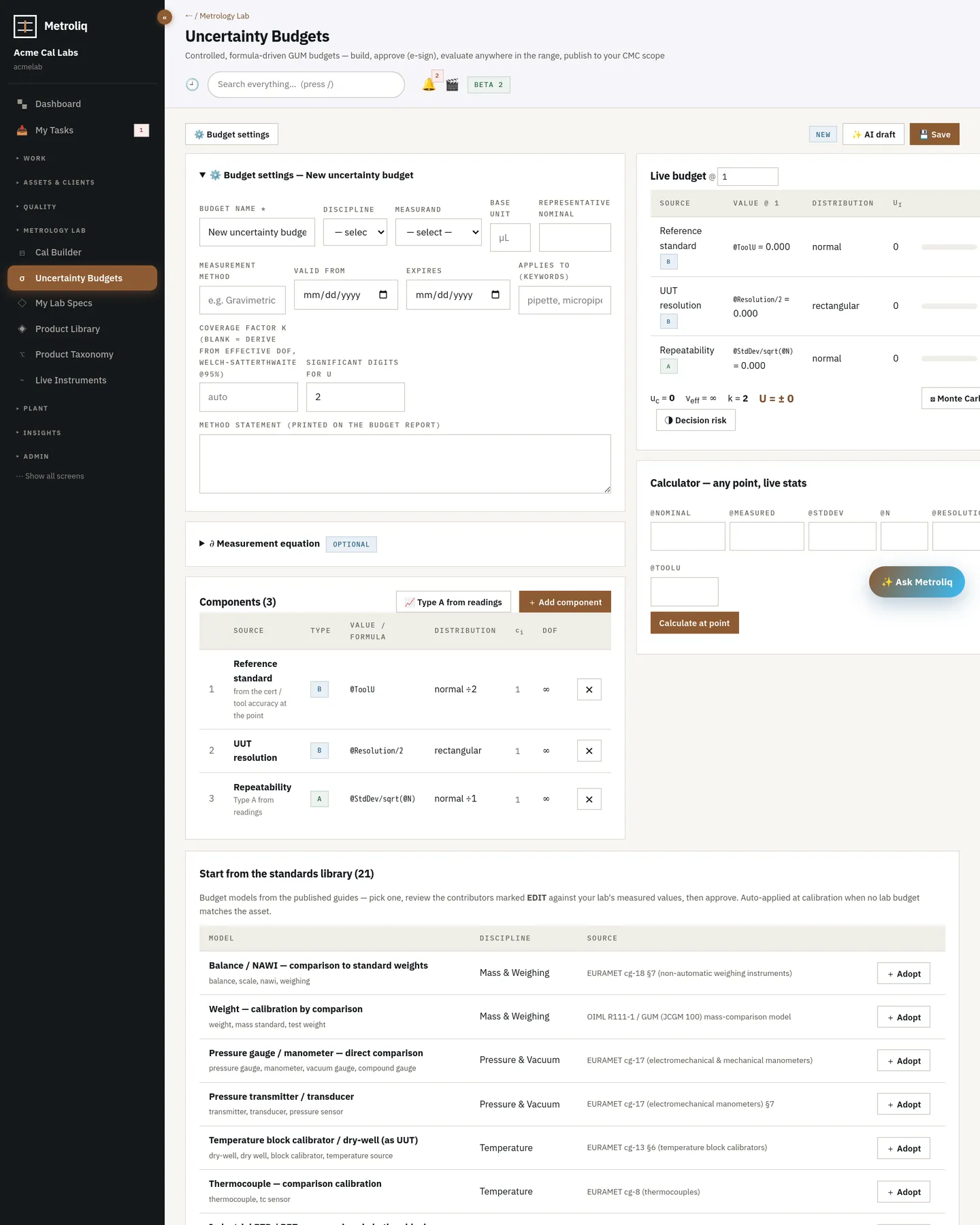
  • Uncertainty study library from published guides; evaluate at any point in range; e-signed approval; HTML report; publish as a CMC line
  • Expanded U rounded to two significant figures on the certificate; TUR and PFA use the unrounded value
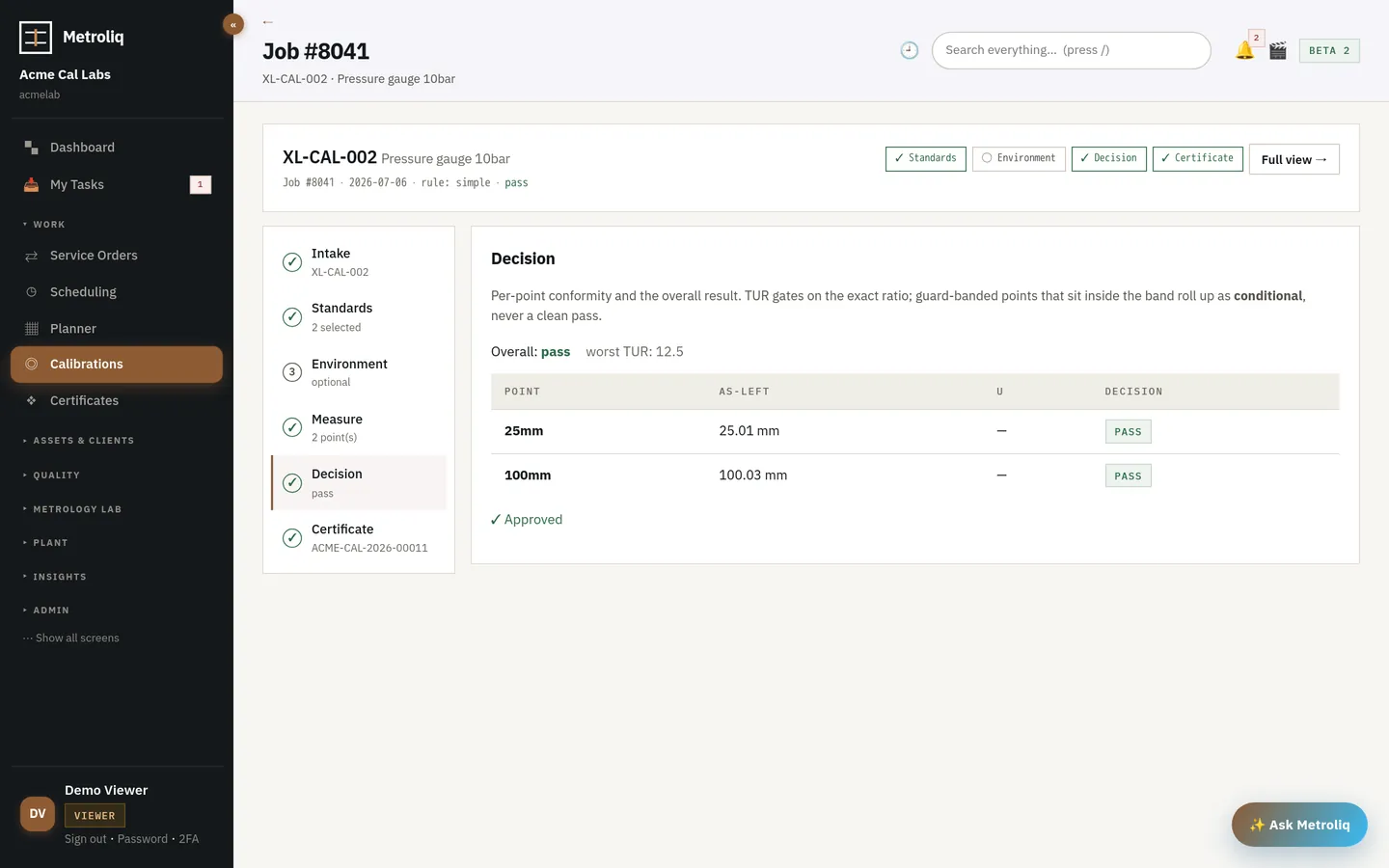
Decision stage showing verdict per point with guard band and PFA
The decision stage: verdict per point, guard band, probability of false acceptance, and the rule statement that will print on the certificate.

Decision rules (ILAC-G8, Z540.3, JCGM 106)

  • Simple acceptance, guard-banded accept, guard-banded reject, PFA target
  • TUR / TAR from the reference standard's typed per-point accuracy, not a guess
  • Specific-risk PFA and PFR, and conformance probability, per point
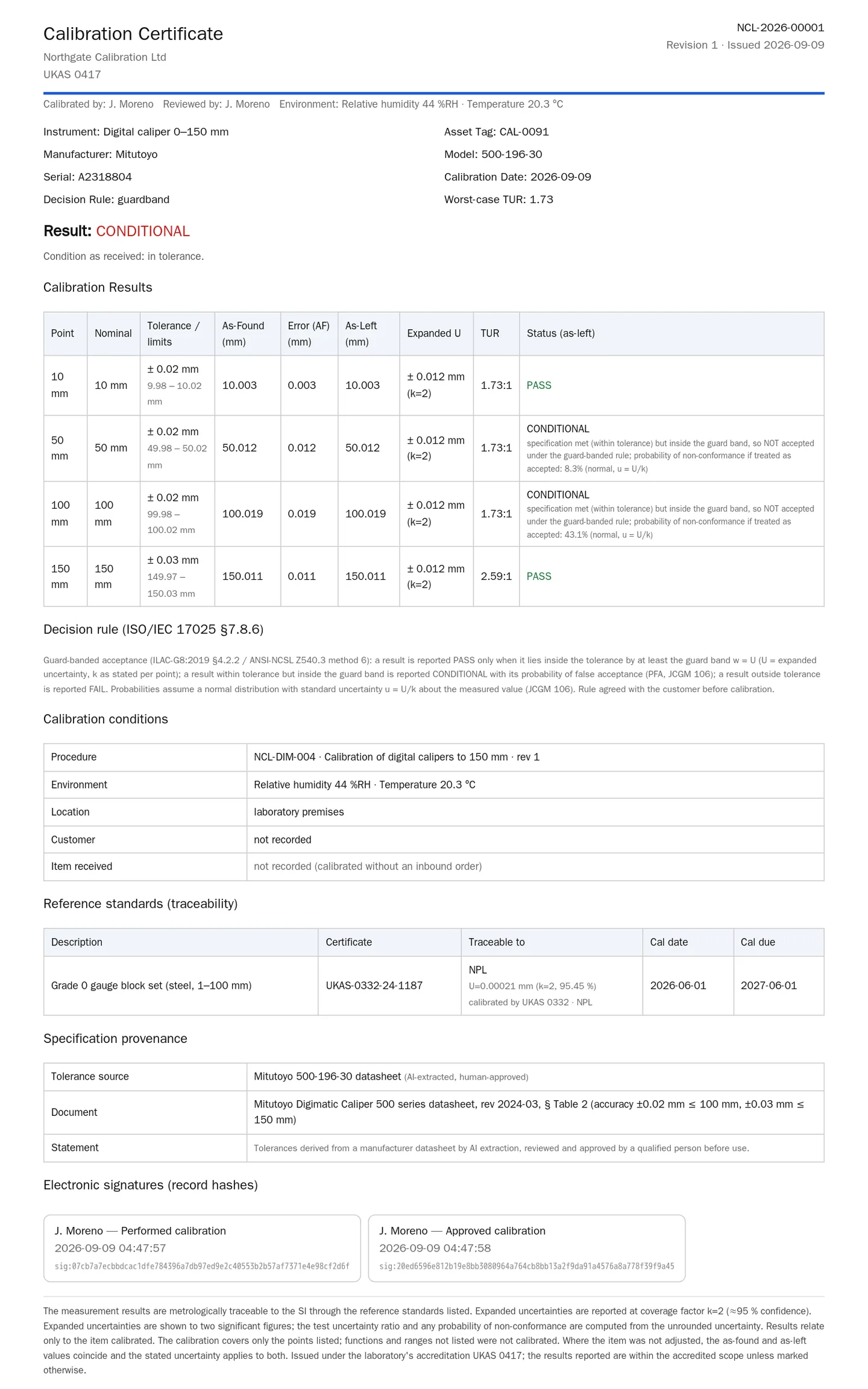
  • CONDITIONAL wording states that the specification is met but the result is not accepted under the rule, with the probability of non-conformance if treated as accepted
  • Zero-width tolerance or missing nominal yields INDETERMINATE rather than a false pass
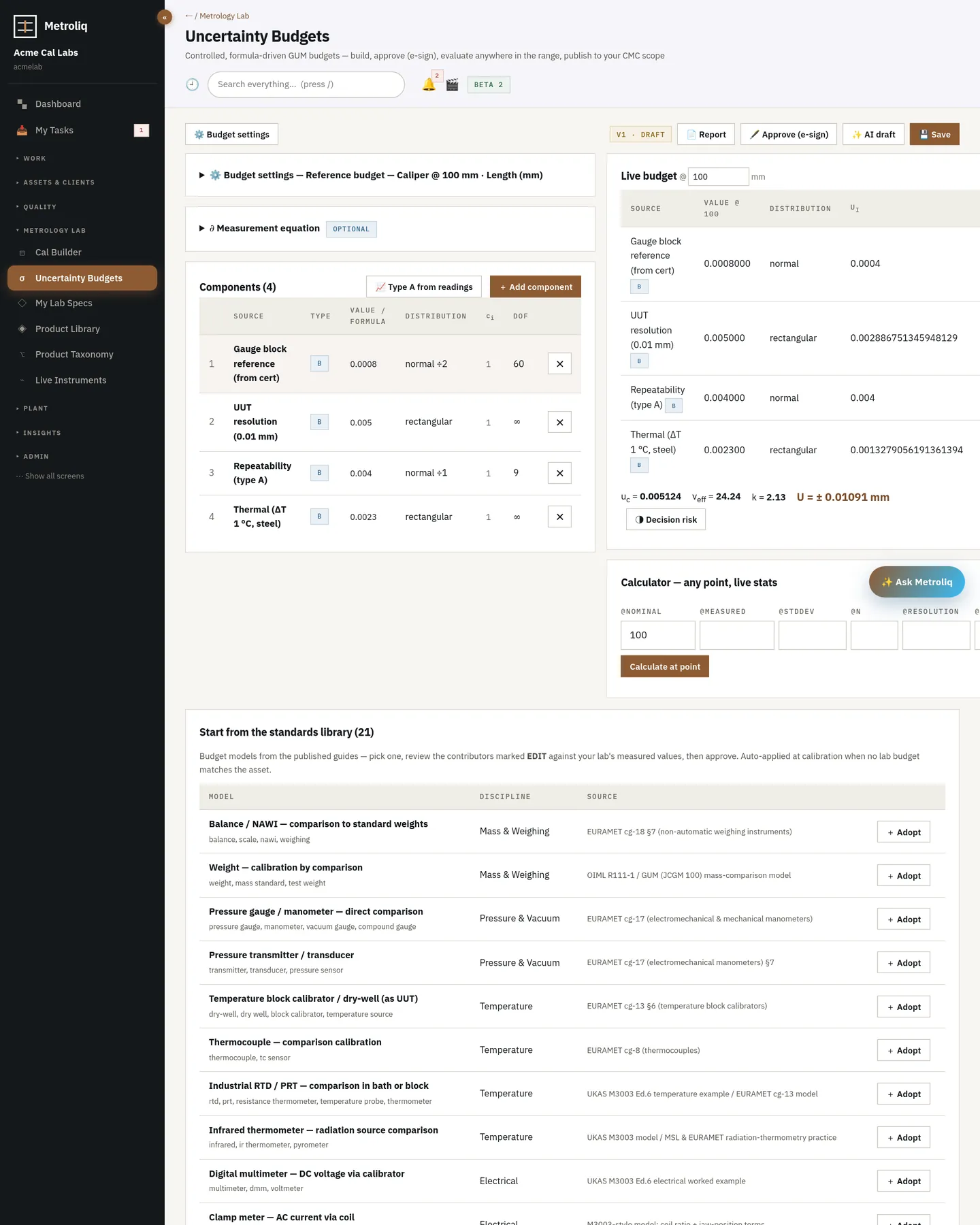
Uncertainty budget editor with contributors, distributions and the measurement equation
An uncertainty study: contributors with distributions and divisors, the measurement equation, combined and expanded uncertainty, and the Monte Carlo cross-check.

Studies and MSA

  • Gage R&R (AIAG) studies
  • Drift and QC control charts per asset; intermediate checks due list
  • Suggested calibration points from the asset's specification, with a wrong-instrument flag when they are far off the asset's capacity
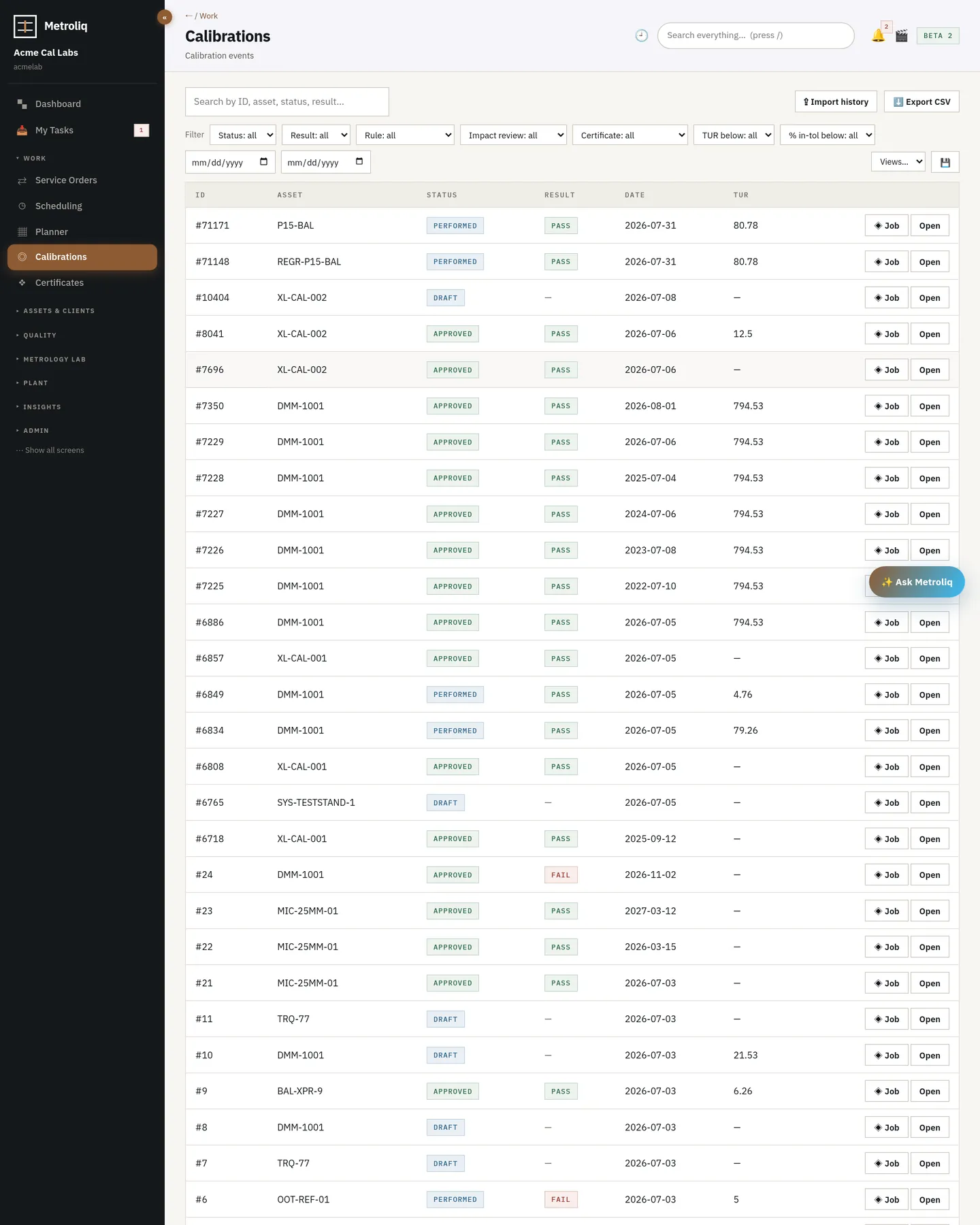
List of calibration events with status and verdicts
Every calibration event with its lifecycle state: draft, performed, approved, voided.

Temperature, loop, MSA & intervals

  • Callendar–Van Dusen and ITS-90 SPRT coefficient sets fitted from calibration points, stored e-signed on the asset, with a resistance-to-temperature converter
  • NIST ITS-90 reference functions for all eight thermocouple types (K, J, T, E, N, S, R, B) with cold-junction compensation and per-asset deviation tables
  • Loop and process calibration with five-point up and down runs, per-direction hysteresis, terminal and best-fit linearity, zero and span trim recorded as the adjustment
  • The full AIAG MSA-4 suite beyond Gage R&R: bias, linearity, stability (X-bar/R) and attribute agreement with Fleiss' and Cohen's kappa, with PDF reports
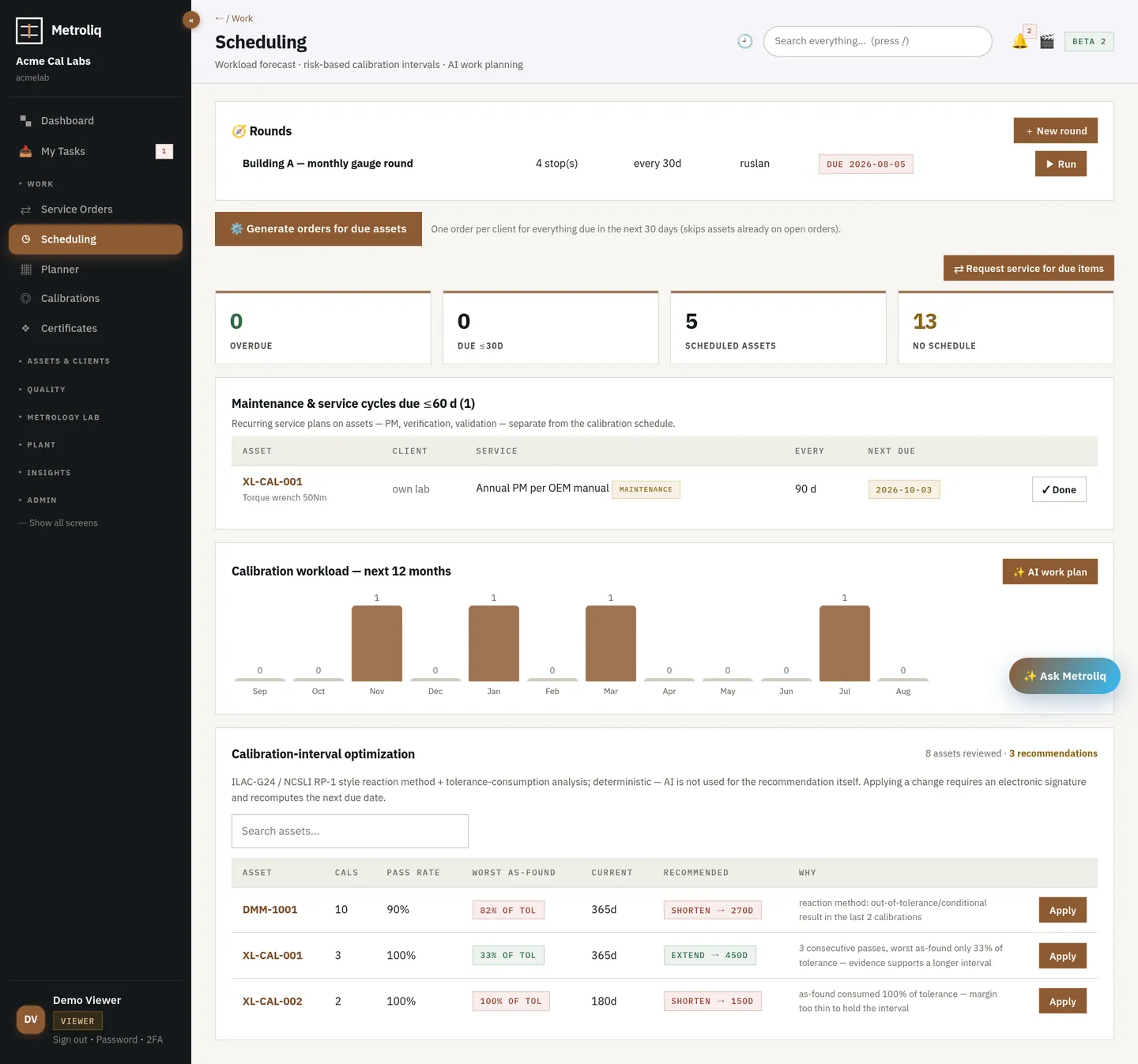
  • NCSLI RP-1 / ILAC-G24 family interval analysis: pooled reliability, Wilson confidence bounds, reaction-method and target-reliability recommendations, one-click e-signed bulk apply
  • ISO 17025 §7.8.2 adjustment disposition on every event, printed on the certificate; OIML R76 / USP <41> balance qualification with eccentricity, repeatability, linearity and minimum weight
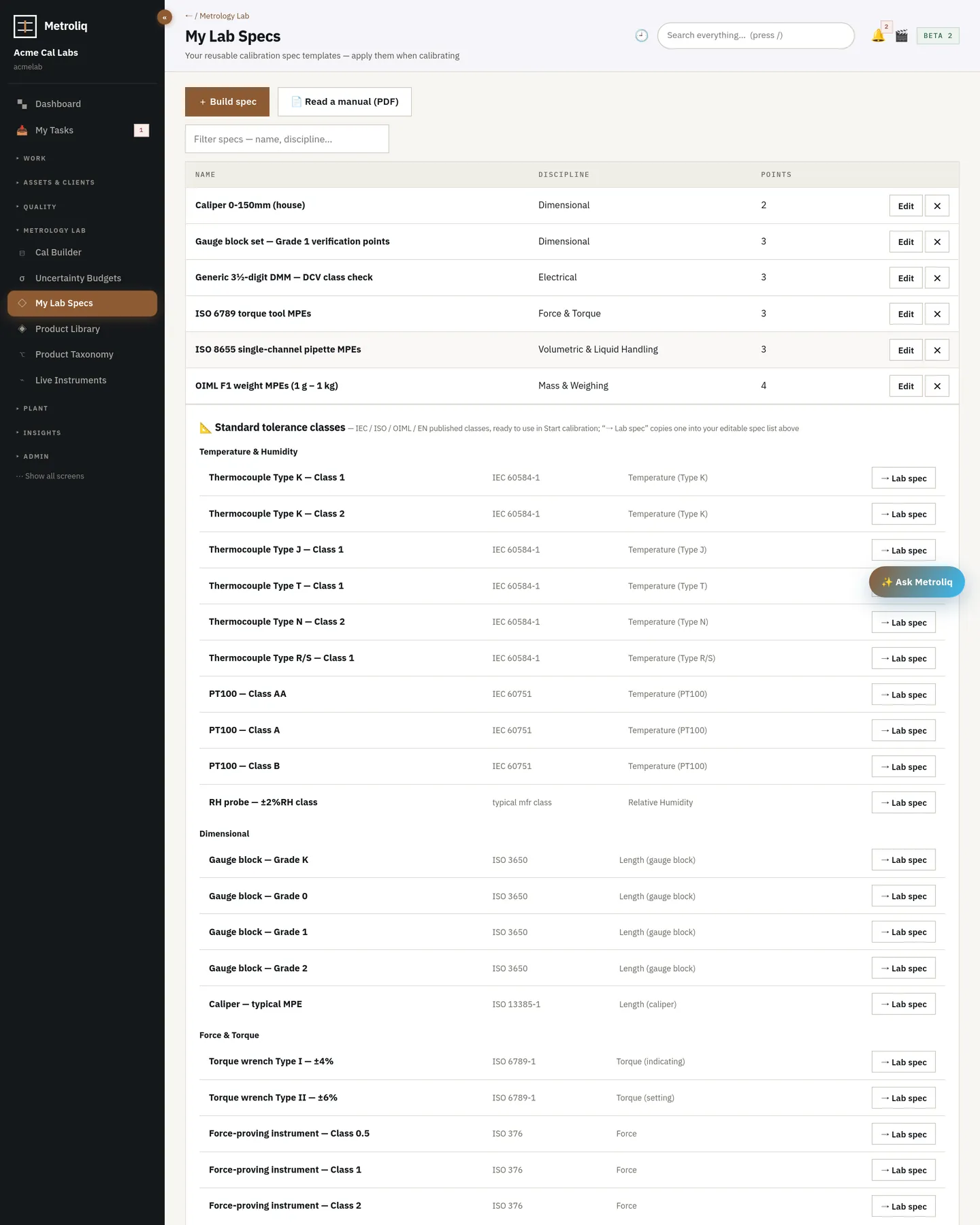
Library of uncertainty studies and templates
Uncertainty studies built from published-guide templates, approved with an e-signature, and publishable as a CMC scope line.

Scan gating & labels

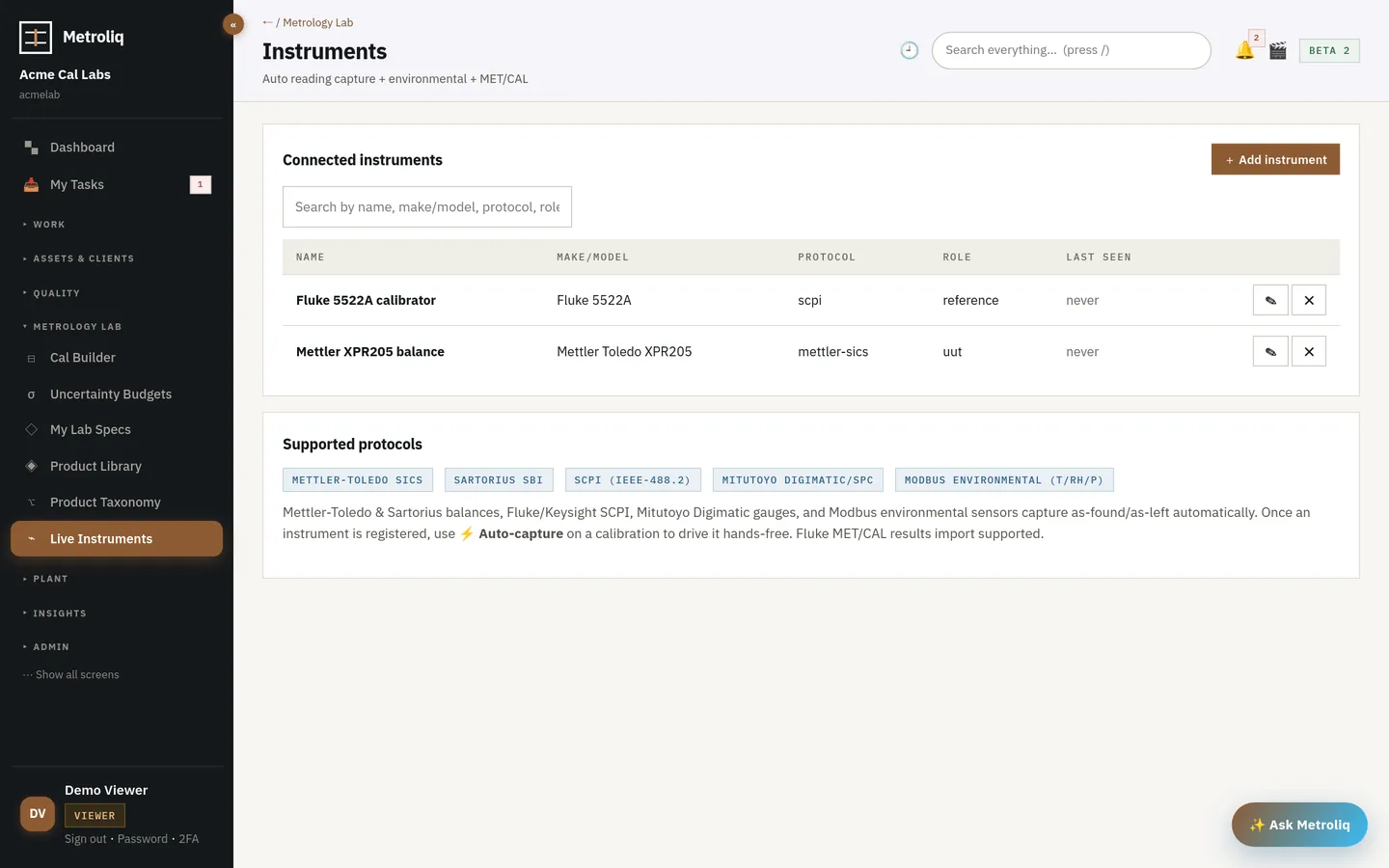
  • Scan gate (off, warn, require) for calibration perform, reference-standard selection, service-order receiving and tool-crib checkout/checkin: no matching physical scan, no action; every match or mismatch logged with expected and scanned codes.
  • WYSIWYG label designer: drag and resize text, barcode, QR, logo and line elements bound to live asset fields; renders to PDF (Code 128 and QR) or ZPL II for thermal printers.
  • Print jobs queue for a printer-bridge agent and never fabricate a print confirmation.
Guided job workspace with points, readings and live TUR and decision columns
The job workspace: points, as-found/as-left readings, and the TUR and decision computed as the reading is entered.

Content packs & migration

  • Ten instrument-family content packs (6½-digit DMM, clamp meter, pressure gauge and transmitter, temperature probe, USP balance, ISO 6789 torque wrench, ISO 13385 caliper and micrometer, ISO 8655 pipette, RF power sensor, flow meter) install a measurement form, an uncertainty-budget skeleton and a procedure in one step. The budget contributors are placeholders that must be replaced with your own certificate and characterisation data before accredited use; the install check only proves the budget computes a finite expanded uncertainty and TUR.
  • Migration importers for Fluke MET/TEAM, IndySoft, Beamex CMX (CSV and XML) and Qualer with documented column mappings and a dry-run reconciliation before writing; Fluke and Transcat certificate PDFs ingested with the original certificate number preserved.
Choosing reference standards for a calibration with validity checks
Reference standards are chosen per job; an overdue standard is refused, and the choice is part of the signed record.

Send-outs, repairs, loaners & witnessed calibration

  • Subcontracted (send-out) calibration from the order line: the vendor must hold an approved or conditional calibration supplier qualification, enforced by the same gate that blocks purchase orders (409, not a warning); outbound and return legs reference a real shipment or a typed consignment number, never a generated one.
  • The subcontractor's certificate is ingested from a Fluke/Transcat text-layer PDF, a DCC, or keyed by hand, and only becomes a workspace certificate after an e-signed endorsement; it prints "performed by <lab>, accreditation <n>, endorsed by <us>" and is marked outside the endorsing lab's accredited scope unless a per-vendor assessment says otherwise. Send-out cost is a separate line in job costing.
  • Found-out-of-tolerance items branch to a repair estimate the customer authorises or declines in the portal (timestamped, audited); a declined repair cannot close without an e-signed statement of non-conformance, and customer-wait days are reported apart from lab days.
  • Loaner pool: loanable assets lent against a service order with custody through the scan gate, due-back digests, rental billed from real price-book rates; an out-of-calibration loaner is refused at issue.
  • Customer-witnessed calibration: witness name, organisation and on-site acknowledgement signature on the event, printed on the certificate and declared not to be a Part 11 signature; a per-customer policy can block approval until recorded.
  • Traceability-chain report walks unit under test → reference standards → their calibrations to the terminal declaration and names every break (no calibration record, standard overdue on the day used, chain ending in text); included in the accreditation assessment pack.
Decision stage showing verdict per point with guard band and PFA
The decision stage: verdict per point, guard band, probability of false acceptance, and the rule statement that will print on the certificate.

Reference standards & traceability

  • Coefficient sets for sensor conversions are preferred when electronically signed; an unsigned set is reported as such and refused outright for GxP laboratories, where the requirement is on by default.
Choosing reference standards for a calibration with validity checks
In the product Reference standards are chosen per job; an overdue standard is refused, and the choice is part of the signed record.
Guards the system enforces

Things it refuses to do

A quality system is defined as much by what it will not accept. These are enforced in the platform, not in a procedure.

refuses

Approve without a Performed signature

Approval is refused (409) until the performing technician has signed.

refuses

Approve your own work when independent approval is on

With the setting enabled the performer cannot be the approver.

refuses

Use an overdue reference standard

Standards are validity-checked at selection; certificate issue is hard-blocked by a stale standard unless an override reason is recorded and audited.

refuses

Issue a budget whose coefficients failed the cross-check

If the derived sensitivity coefficients do not agree with the numerical check, the budget is marked not to be issued.

refuses

Change the environment after approval

Environment edits on an approved event are refused.

Watch

Calibration & uncertainty in under a minute

Every calibration is a numbered event that carries its own points, readings, reference standards, environment and decision rule — and evaluates conformity live, with a full GUM budget per point. Metrology Lab tooling adds ITS-90 SPRT and thermocouple reference functions, loop and process calibration with hysteresis, the full AIAG MSA-4 suite and NCSLI RP-1 / ILAC-G24 interval analysis, all e-signed onto the asset. A barcode/QR scan gate on perform, standard selection, receiving and crib custody, plus a WYSIWYG label designer with PDF/ZPL output, keep physical identity tied to the record.

Try it · Decision rule

Move the sliders. This is the platform's decide() logic.

Tolerance, expanded uncertainty and the measured error. Switch between simple acceptance and the ILAC-G8 guard band, and watch the verdict, the acceptance limit and the probability of false acceptance change.

Decision stage showing verdict per point with guard band and PFA
In the product The decision stage: verdict per point, guard band, probability of false acceptance, and the rule statement that will print on the certificate.
Why it's different

Compared with what is out there

Static U

Calibration-first tools store the uncertainty you typed in at setup.

A real budget changes with the standard you used, the resolution of the unit under test and the repeatability you observed. Metroliq computes it on every event, and the certificate prints the budget's result, not a default.

Verdict

Most systems store the verdict someone worked out elsewhere.

Here the verdict is a function of the reading, the tolerance, the uncertainty and the named rule. The same function drives the app, the HTML, the PDF and the DCC, so they cannot disagree.

Assessor

The assessor sees the maths on the certificate.

Decision rule, guard band, coverage probability, TUR and the standards used are on the page an assessor reads — not in a side spreadsheet.
Beta · free while we build it with the first labs and plants

Bring one lab and your real history.

The tour runs the working platform, not a mockup. Pilot on your own instruments with your own imported history — we set it up with you, and fixes ship in hours and days, not release cycles.