metroliq
CalibrationCertificates & DCCQuality (QMS)Documents & trainingInstruments & captureSchedulingMaintenance (CMMS)Assets (EAM)Manufacturing (MES)Field serviceParts & inventoryService pipelineCustomer portalAI buildersIntegrations & APIComplianceWorkspace & admin
Manufacturing execution · MES

Batch records that execute.

Recipes and BOMs, production orders, versioned work instructions and electronic batch records that run: steps in order, each with its own e-signature, exceptions dispositioned, and the batch moving itself to review when the last step closes. Review-by-exception batch release, seven new batch-record step types, in-process SPC with Nelson-rule detection, and scale-in-the-loop dispensing with barcode verification extend execution beyond numeric entry.

Line clearance, in-process deviations and material dispensing are steps on the record. The instruments used in a batch are checked for calibration status at the moment of use, and an out-of-limit step opens a deviation in the same quality system. Genealogy and lot where-used answer the recall question in one query. Z1.4 sampling plans, an out-of-specification workflow tied to disposition, and GS1 serialization with EPCIS aggregation now sit in the same quality system as the batch record. The full ANSI/ASQ Z1.4 table set with automated normal/tightened/reduced switching, LIMS-depth sample login, worksheets and ICH Q1E stability studies, and EPCIS import with receiving reconciliation and DSCSA-style serial lifecycle now extend that same quality system end to end.

See it in the tour Every capability
Instrument check at uselive
Signaturesper step
Release gateno open deviation
Tracegenealogy · where-used
In the product

What it looks like

Screens from the live platform, demo tenant. Click any screen to open it full size.
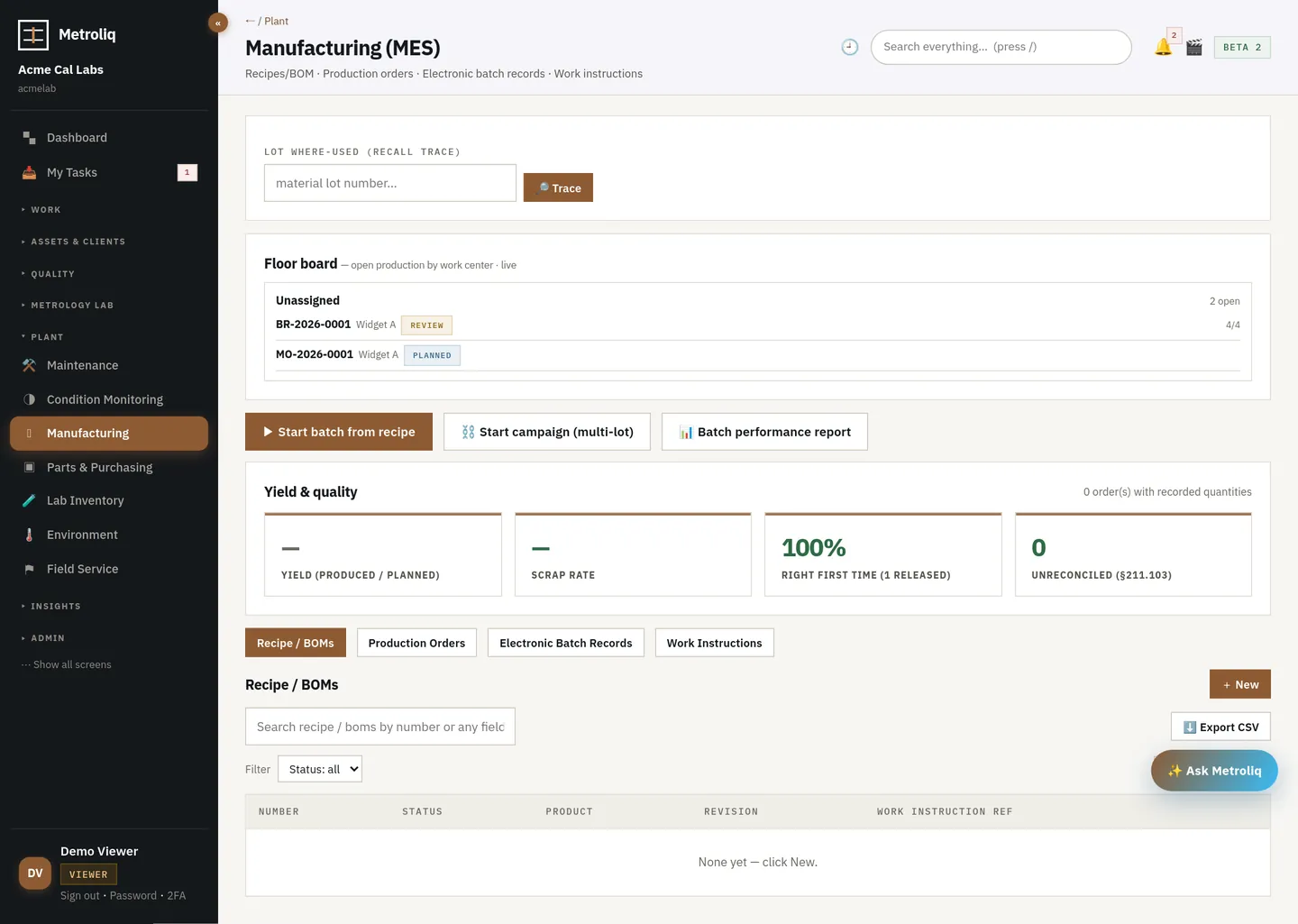
Manufacturing execution with batches, steps and floor board
Batches in progress, the floor board, and the steps waiting on a signature.
How it works

From the first record to the signed result

  1. 01
    Define

    Recipe, BOM and versioned work instructions.

  2. 02
    Start

    A campaign or a batch; line clearance recorded.

  3. 03
    Execute

    Steps in order. Each takes its own e-signature; limits are checked as values are entered.

  4. 04
    Handle exceptions

    Deviations and exceptions are records with dispositions; the batch cannot release while one is open.

  5. 05
    Release

    The batch moves to review when the last step closes; the record prints as a controlled document.

What it includes · 54 capabilities

Everything in the module

Definition

  • Recipes and BOMs with materials
  • Production orders and campaigns
  • Versioned work instructions

Execution

  • Ordered step execution with per-step e-signature
  • Line clearance, in-process deviation, material dispensing
  • Exceptions and dispositions
  • Instrument calibration status checked at the moment of use
  • Batch release only from review, with every step executed and line clearance passed; production quantities required (or an audited override with a reason)
  • Executed steps can never be re-initialised; executed values, operators and signatures are immutable
  • Dispensing is e-signed and checked against the bill of materials; off-BOM material needs an override reason and becomes a reviewable exception
  • Lots are unique per product; each batch snapshots the exact recipe and work-instruction revision it ran under
  • Concurrent edits are detected: two operators cannot overwrite each other's steps or dispenses

Traceability and analysis

  • Genealogy, material-lot where-used, lot trace
  • OEE, yield report, MES analytics, floor board
  • Equipment ↔ batch usage per asset
  • Batch record printed as a controlled record document

Dispensing & scanning

  • Scale-in-the-loop dispensing: tare, gross and net captured from a registered balance; a scale-required policy refuses typed weights
  • Dispensing policy per tenant and per recipe: typed, scale-preferred or scale-required; a capture is blocked when the balance's own calibration is overdue
  • Potency and assay-adjusted targets with the arithmetic shown on the record; partial-container tracking and expected-versus-dispensed reconciliation with variance
  • GS1-128 and plain barcode verification against the BOM and lot register, by phone camera or keyboard-wedge scanner; a reusable scan component for the rest of the app
  • Printable dispense labels with QR and an audited reprint counter

Review by exception & SPC

  • Review-by-exception batch release: reviewers see only flagged exceptions; release needs an e-signed reviewed-by-exception assertion from someone other than the releaser (segregation of duties), opt-in per tenant
  • Seven new batch-record step types beyond numeric entry: yes/no with a mandatory comment on no, multiple choice, server-computed calculations (safe formula parser), start/stop timers with over-duration flags, photo steps, second-person countersigned verification and read-and-acknowledge instructions
  • Parallel step groups, dependencies and conditional auto-skip in batch checklists
  • In-process SPC: control-chart series per recipe step or named critical attribute, Nelson rules 1/2/3/5/6 evaluated live, exceptions raised automatically; Cp, Cpk and Ppk on demand
  • Batch review queue and metrics (open exceptions, review time, exceptions by type) and a printable review-by-exception record

QC, LIMS & serialization

  • ANSI/ASQ Z1.4 sampling: lot size to code letter to sample size (general levels I–III), used by sampling plans or standalone.
  • QC sampling plans with numeric and attribute tests, samples with chain of custody, e-signed result entry that checks the instrument's calibration status.
  • Out-of-specification workflow (initial assessment → lab investigation → full-scale → disposition) opened automatically on any failing result, linked to a deviation, with retest tracking.
  • Material-lot disposition (quarantine, released, rejected, on hold) e-signed; on-hold lots cannot be dispensed; batch release requires finished-goods tests to pass or a dispositioned OOS, alongside the review-by-exception gate.
  • Certificate of Analysis PDF generated from recorded results and disposition; LIMS export (JSON, CSV, ASTM-style), e-signed reconciled import and a results-push webhook staged for human review.
  • GS1 serialization: SGTIN and SSCC commissioning with check digits, aggregation trees, UDI-DI/PI composition and EPCIS 2.0 JSON-LD event export.

ISA-88 batch orchestration

  • ISA-88 master recipes as unit procedure → operation → phase trees with equipment class and required state per unit procedure, versioned and gated behind an approved change control; control recipes run on the existing step engine.
  • Equipment states (idle, clean, dirty, in use, hold, maintenance) with clean-hold and dirty-hold expiry; a phase cannot start until its equipment is in the required state; e-signed transitions land in the GxP logbook.
  • Phase-level QA hold points with e-signed placement and release; golden-batch trajectory comparison with a computed envelope that flags excursions.
  • Procedural state model with seven states (idle, running, held, restarting, aborting, aborted, complete) enforced through one transition table; hold and abort cascade to running descendants in one transaction. Unit allocation is arbitrated by a database constraint (a second batch claiming held equipment gets a 409 naming the holder). Batch-size scaling is previewable: materials scale linearly, parameters only when a phase opts in. The equipment-module command/acknowledge loop is simulated, marked as such on every command, with timeouts surfacing in the review-by-exception workbench. No PLC or DCS claim is made.

Acceptance sampling (Z1.4)

  • The complete ANSI/ASQ Z1.4 single and double sampling tables with acceptance and rejection numbers, arrow-chase and 100%-inspection resolution, general levels I–III and special levels S-1 to S-4, transcribed and verified cell by cell.
  • Automated switching per plan, supplier or product: normal to tightened after 2 of 5 rejected lots, tightened back to normal after 5 accepted, tightened to discontinued with manual reinstatement, normal to reduced after 10 accepted lots within the Table VIII limit with approval, reduced back to normal on a rejection; full history kept.
  • One-call lot evaluation returns sample size, Ac, Re, the decision and the switching outcome for single or double sampling, with an automatic hook from attribute QC results; plan configuration is versioned and audited.
  • All seven inspection levels (general I–III, special S-1 to S-4) resolve through one Table I lookup; an unrecognised level is refused rather than treated as level II. The master tables are re-derived in CI against a second published transcription (12,747 cell comparisons; five transcription defects were found and fixed this way).

LIMS depth

  • Sample login with a numbered sequence, matrix and storage tracking, parent and child aliquots, and printed sample labels (PDF or ZPL) through the label engine.
  • Worksheets group tests for one instrument run and are refused when the instrument's calibration is overdue; analysts can be assigned only when training records show competence for the method; method parameters and limits are versioned and every result records the version it was graded against.
  • Reagent and reference-material lots with expiry: result entry is blocked on an expired lot; calculated results use the safe formula engine; second-person review and approval with segregation of duties and e-signatures; out-of-spec results open the shared OOS investigation.
  • Stability studies with condition and timepoint pull scheduling and ICH Q1E shelf-life estimation (linear regression, one-sided 95% confidence, worst case across conditions).
  • ICH Q1E §II poolability: ANCOVA F-tests on slopes then intercepts at α = 0.25 across stability batches, never mixed across storage conditions, with a from-scratch F-distribution; the fixture is hand-computed with every sum of squares shown because no published worked example with raw data was found.
  • Instrument-file parser SDK: versioned, e-signed parser definitions (draft → review → approved → retired) for CSV/TSV/fixed-width with Waters Empower and Agilent OpenLab export templates (document-derived, unvalidated against live instruments), dry-run → parse → review → bind through the existing result-entry gates, and a checksum-vaulted raw-file store with an append-only chain of custody.
  • Environmental monitoring programme: locations and sampling points with alert/action/spec limits, schedule generation from daily to per-shift with missed-window detection, one-click collection into a real LIMS sample, action- or spec-level excursions opening a numbered deviation, Nelson-rule control charts per point, a capacity calendar flagging over-booked days, and audited e-signed result invalidation that removes a result from every statistic, report, CoA, poolability test and ERP push while keeping it struck-through on the record.

Serialization exchange

  • EPCIS 2.0 JSON-LD and 1.2 XML import with dry-run preview, de-duplication and automatic status mapping; receiving reconciliation against expected serials per shipment or PO (matched, missing, unexpected).
  • Full serial lifecycle (commissioned, packed, shipped, received, decommissioned with reason) with e-signed recommission; DSCSA VRS-style saleable-returns verification by GTIN and serial with full history.
  • Trading-partner profiles with SFTP and HTTPS delivery of EPCIS documents and a delivery log; DSCSA and EU FMD submission status per batch, manual or through a configurable adapter; AS2 stays a documented hand-off.
  • Trading partners POST EPCIS 2.0 JSON-LD or EPCIS 1.2 XML to a capture endpoint with a per-partner key or client certificate; capture is idempotent by event id, dry-runnable and logged. A standard SimpleEventQuery endpoint answers eventTime/bizStep/action/EPC filters with paging, scoped to the tenant and the partner's visibility. Captured events drive the serial lifecycle and shipment reconciliation. Subscriptions, named queries and MasterData capture are not implemented and the discovery endpoint says so.
  • The AS2 simulator answers an unknown partner, an undecryptable payload, a bad signature and a wrong certificate with one identical refusal, so it cannot be used to discover which trading partners exist, and repeated message ids are rejected behind the cryptographic check rather than in front of it.

Acceptance sampling (Z1.9 variables)

  • ANSI/ASQ Z1.9 variables sampling: Table A-2 code letters and Table B-1/B-2 s-method plans (n, k, M), Form 1 (k method) and Form 2 (M method) lot disposition on real measurements, normal/tightened/reduced switching on the same audited engine as Z1.4. Plan tables are re-derived in CI against a second source; the k column is computed (beta-quantile) and excluded from that check, as stated on the test line. Range method (Table C-1) and known-σ (Table D) are refused with a reason, not approximated.

Serialization conformance workbench

  • EPCIS 2.0/1.2 conformance validator (structure, GS1 check digits, CBV vocabulary, 23 error codes), partner conformance profiles, a 30-document test corpus, aggregation/duplicate/replay scenarios against the live capture endpoint, a clearly labelled AS2 loopback simulator (CMS signing and encryption, MIC, replay idempotency, signature-failure MDN; inbound authenticated only by a signature under the peer's registered certificate) and VRS/NMVS mock endpoints. No production AS2 claim.
Guards the system enforces

Things it refuses to do

A quality system is defined as much by what it will not accept. These are enforced in the platform, not in a procedure.

refuses

Release with an open deviation

Blocked while any linked or referenced NCR or deviation is open.

refuses

Use an out-of-calibration instrument in a step

The instrument's status is checked at use.

Watch

Manufacturing execution (MES) in under a minute

Recipes and BOMs, production orders, versioned work instructions and electronic batch records that run: steps in order, each with its own e-signature, exceptions dispositioned, and the batch moving itself to review when the last step closes. Review-by-exception batch release, seven new batch-record step types, in-process SPC with Nelson-rule detection, and scale-in-the-loop dispensing with barcode verification extend execution beyond numeric entry.

Try it · Executable step

Enter a value. See the step decide.

A weighing step with a limit and a balance. Change the value or the balance's calibration status and watch the step sign, open a deviation, or refuse.

Why it's different

Compared with what is out there

Balance

MES suites don't know if the balance was in calibration.

Metroliq refuses an instrument that isn't, at the step, and records which balance was used.

One CAPA

Quality events from the line and from the lab go to the same CAPA process.

A deviation on a batch and an out-of-tolerance on a gauge are the same kind of record on the same audit trail.
Beta · free while we build it with the first labs and plants

Bring one lab and your real history.

The tour runs the working platform, not a mockup. Pilot on your own instruments with your own imported history — we set it up with you, and fixes ship in hours and days, not release cycles.