metroliq
CalibrationCertificates & DCCQuality (QMS)Documents & trainingInstruments & captureSchedulingMaintenance (CMMS)Assets (EAM)Manufacturing (MES)Field serviceParts & inventoryService pipelineCustomer portalAI buildersIntegrations & APIComplianceWorkspace & admin
Instruments · bench capture · environment

Readings captured at the bench, checked as they land.

Real device drivers — Mettler-Toledo and Sartorius balances, Fluke and Keysight SCPI instruments, Mitutoyo Digimatic, Modbus sensors — drive the instrument through the procedure and record what it actually read. OPC-UA, MQTT and Modbus edge ingestion binds live sensors to assets, batch steps and SPC series, and a documenting-calibrator bridge exports task packages and imports results with reconciliation and e-signed apply. A downloadable on-prem bridge now speaks serial or TCP directly to bench instruments — thirteen fixture-tested drivers, disk-buffered through outages, running as a Windows, Linux or macOS service.

Each reading is evaluated against its tolerance and guard band live. Environment zones log temperature, humidity and pressure continuously; an excursion is assessed for impact on the calibrations performed during it. Reference standards carry typed ranges and per-point accuracy, so TUR is exact rather than estimated, and a capability search tells you which standard can cover a job. PI Web API and AVEVA Historian connectors, plus one-click Kepware tag import, bring an existing plant historian into the same live evaluation, with critical-tag gap alarms that flag an in-process batch for release review.

See it in the tour Every capability
Retyped readings0
Driver familiesbalances · SCPI · Digimatic · Modbus
Environmentzones + impact
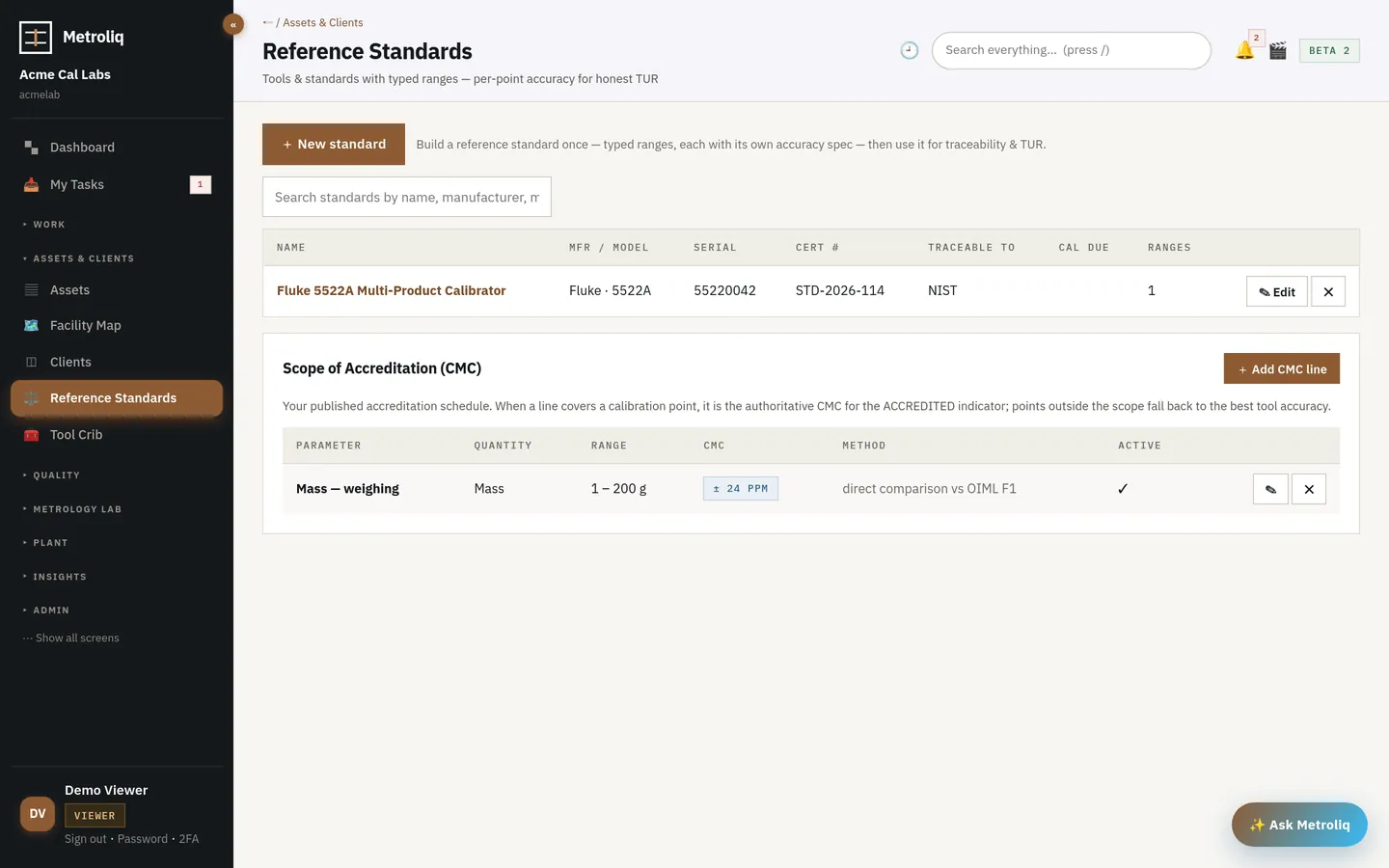
Standardstyped per-point accuracy
In the product

What it looks like

Screens from the live platform, demo tenant. Click any screen to open it full size.
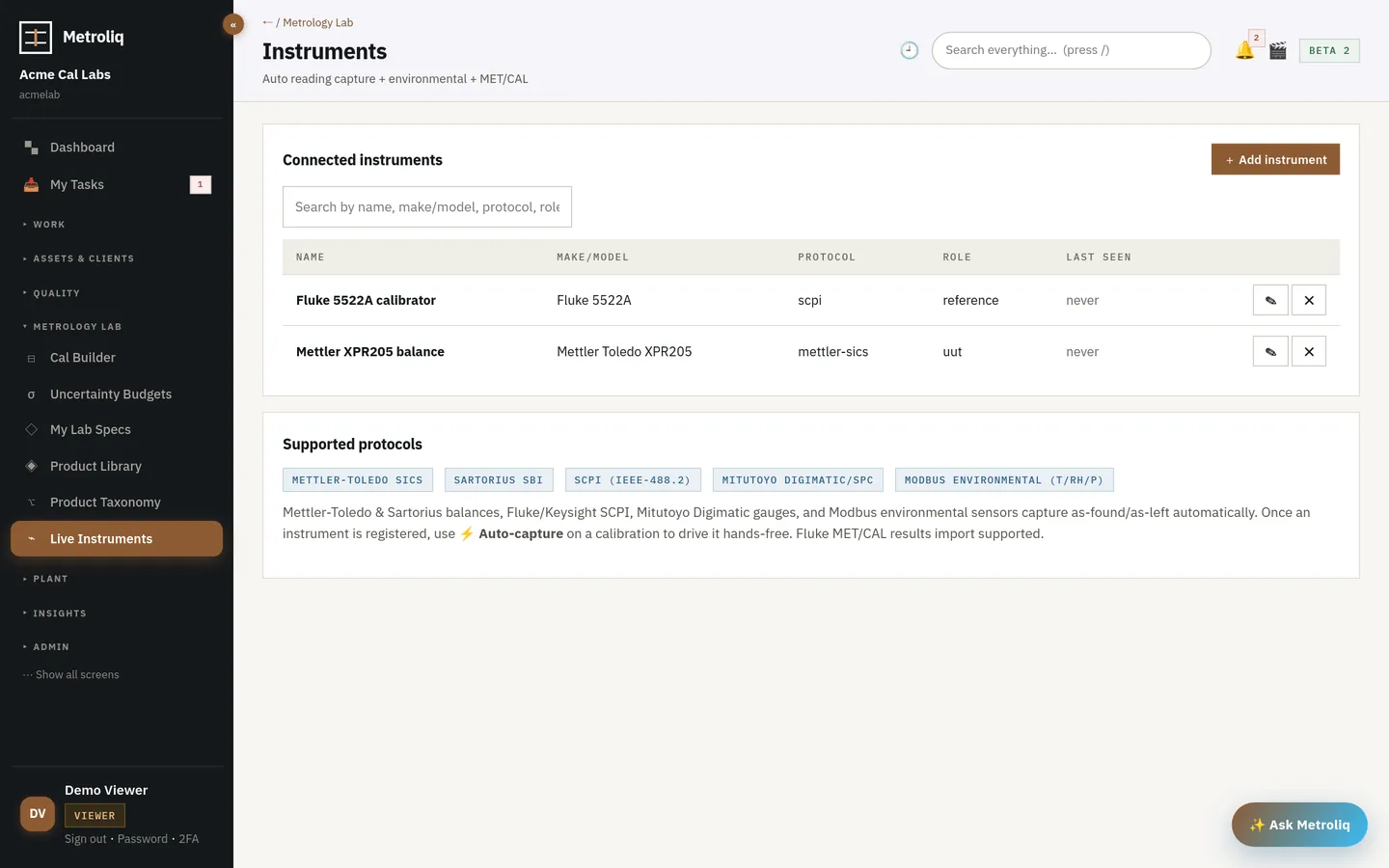
Instrument hub with connected devices and drivers
The instrument hub: connected devices, their drivers, and the hands-free capture status.
How it works

From the first record to the signed result

  1. 01
    Register the device

    A driver from the registry; the device appears in the hub with its identity.

  2. 02
    Start the auto-run

    The procedure drives the instrument through its points; readings arrive without a keyboard.

  3. 03
    Check as you go

    Each reading is evaluated against the tolerance and the guard band; out-of-tolerance is flagged before you move on.

  4. 04
    Record the conditions

    Environment readings from the zone are attached to the event and printed in words on the certificate.

  5. 05
    Sign

    The technician signs the performed event; the approver signs separately.

What it includes · 36 capabilities

Everything in the module

Capture

  • Device and driver registry via the instrument hub
  • Hands-free auto-run through the procedure
  • Live evaluation of each reading against tolerance and guard band
  • Readings recorded as read, not as typed
Reference standards with typed ranges and per-point accuracy
Reference standards with typed ranges and per-point accuracy — the basis of an exact TUR.

Reference standards

  • Typed ranges and per-point accuracy; accuracy formulas need a real term (±0 is refused)
  • Capability search: which standard can cover this job
  • Standards created from the product catalog
  • Intermediate checks due list
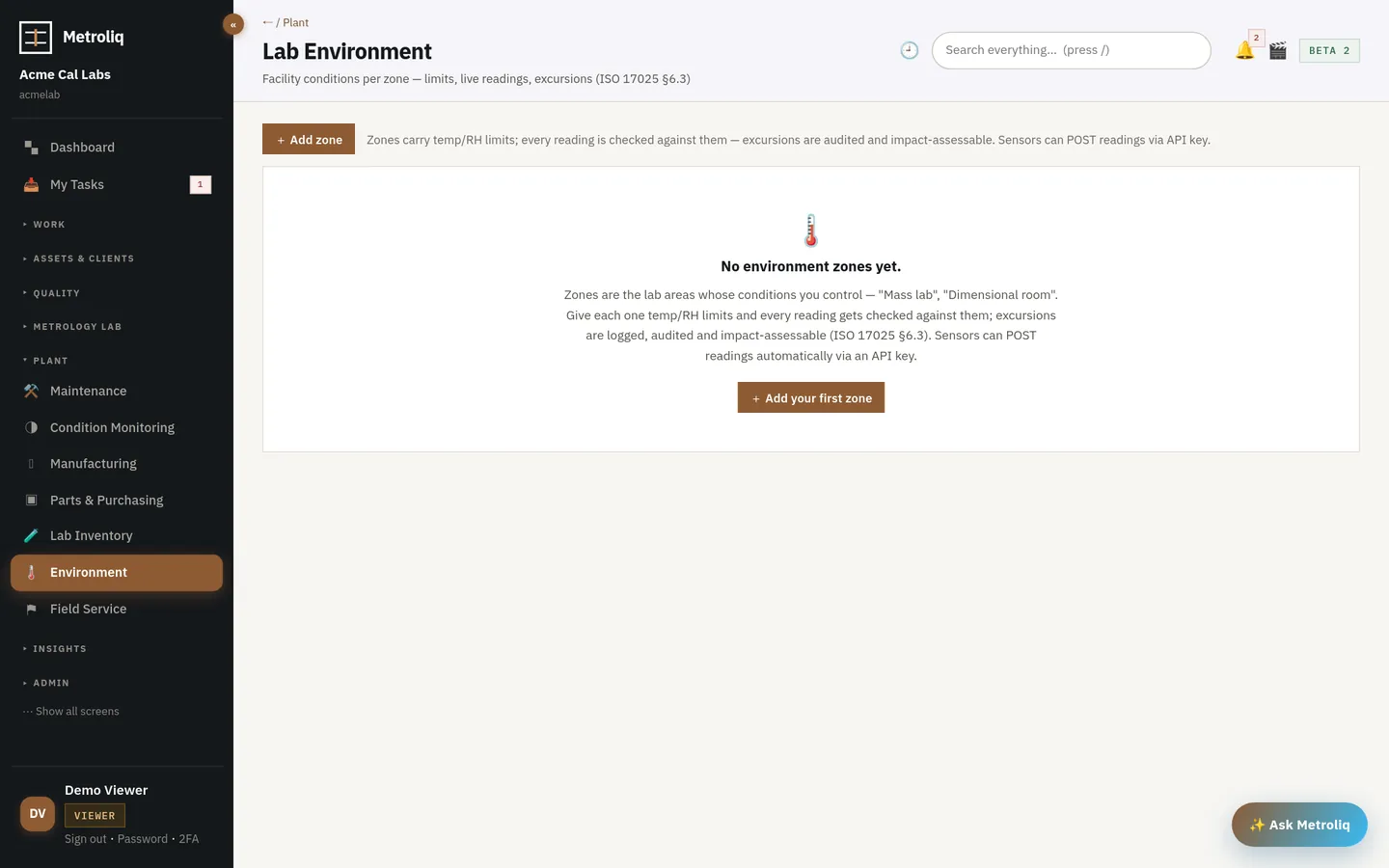
Environment zones with readings and limits
Environment zones: readings against limits, and impact assessment when a limit is crossed.

Environment

  • Environment zones, readings and limits per lab
  • Impact assessment of an excursion on the calibrations performed during it
  • Environment limits checked at perform
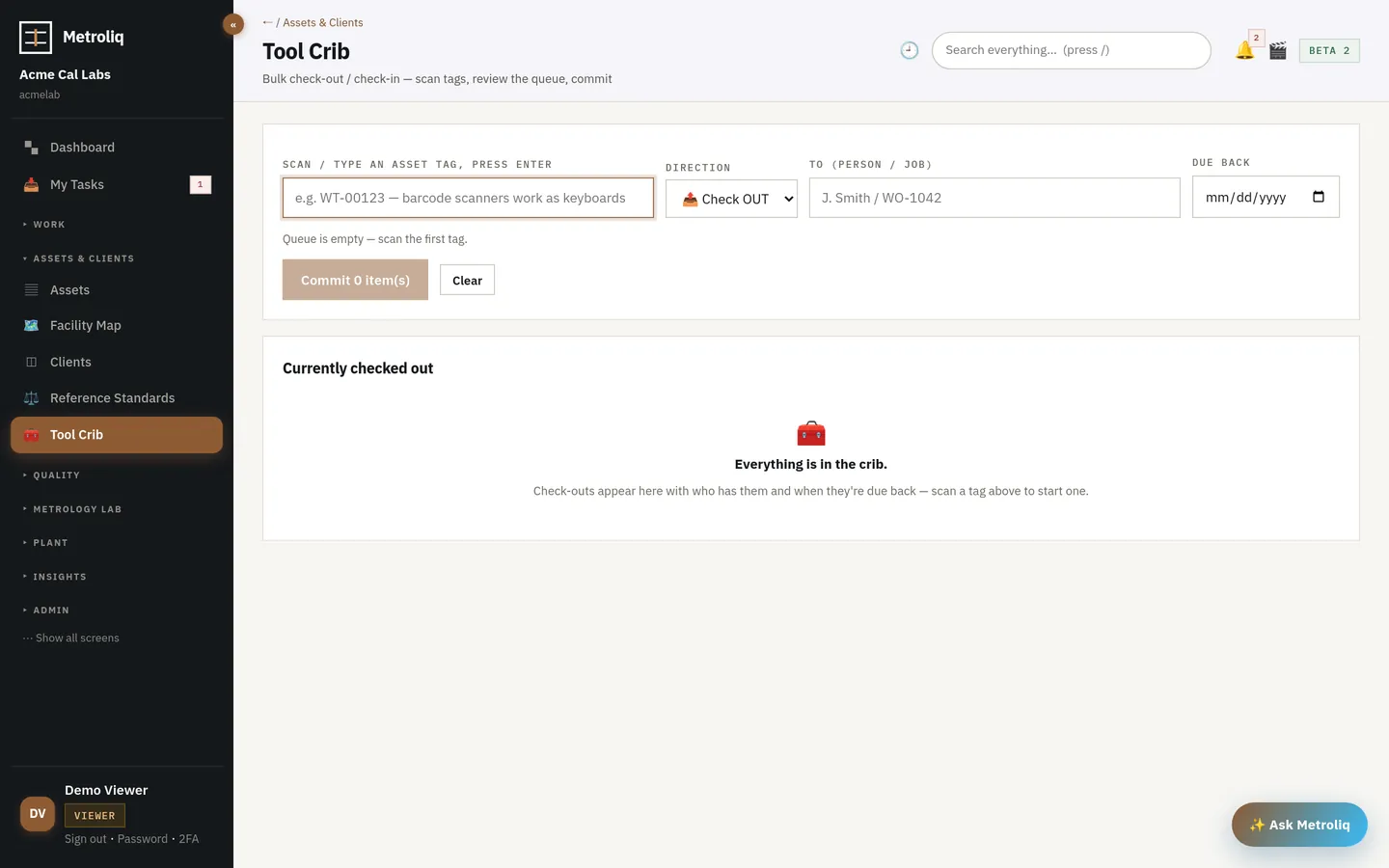
Tool crib check-out and check-in
Custody: tool-crib check-out and check-in, and trip kits for field jobs.

Custody

  • Tool-crib check-out and check-in with history
  • Trip kits per field job
  • Reference standard validity checked against its own calibration due date
Instrument hub with connected devices and drivers
The instrument hub: connected devices, their drivers, and the hands-free capture status.

Edge & sensors

  • OPC-UA subscriptions, MQTT (JSON or Sparkplug-shaped payloads) and Modbus TCP polling feed a tag registry that binds each sensor to an asset meter, an environment zone, an in-process batch step, a condition-monitoring rule or an SPC series
  • Every accepted reading is kept in a monthly-partitioned, de-duplicated raw-value audit trail, real or simulated, always labelled
  • Sensor captures on a batch step are append-only; an out-of-limit reading flags an exception that stays until a reviewer dispositions it
  • Limit and data-quality alarms de-duplicate and are acknowledged with a full audit trail; on-disk buffering with ordered replay survives a lost link to the platform
  • Hardware-free simulation exercises every binding path for OQ, always flagged as simulated and refused against a released batch
Reference standards with typed ranges and per-point accuracy
Reference standards with typed ranges and per-point accuracy — the basis of an exact TUR.

Calibrator bridge

  • Task-package export per calibration event (JSON, XML, CSV) plus a MET/CAL-compatible procedure stub and a Beamex-style CSV, with the supported subset stated in the file and at the schema endpoint
  • Results import from MET/CAL, CSV or JSON with a reconciliation report (matched, unmatched, tolerance mismatch, duplicates) before anything touches a reading; apply is e-signed by the performing technician with SHA-256 provenance on every import
  • Auto-run capture policy per measurement-form point: settling time, sample count, stability window and retry on unstable; the sampled Type A (s/√n) feeds the point's uncertainty budget as the repeatability contributor
  • Driver test harness runs raw frames through the real parser with no device attached; simulated devices replay fixtures through the same parser, always labelled sandbox
  • Per-device command overrides for firmware dialects, a full read and command I/O log, and a compatibility matrix of drivers × registered devices × last test result
Environment zones with readings and limits
Environment zones: readings against limits, and impact assessment when a limit is crossed.

On-prem bridge & drivers

  • A downloadable on-prem instrument bridge (Node) speaks serial or TCP to bench instruments and relays readings and commands to the platform, buffered to disk through any outage; runs as a service on Windows, Linux or macOS.
  • Device pairing with one-time tokens exchanged for a device-scoped credential; a compromised bench PC exposes only the one device it was paired to.
  • Thirteen fixture-tested drivers: Fluke 8845A/8846A/8588A, Keysight 34461A/34465A, Fluke 5522A/5730A calibrators, Mensor and Druck pressure controllers, Fluke 1586A, Additel, Ohaus, Sylvac/Mahr, plus the original Mettler, Sartorius, SCPI, Mitutoyo and Modbus drivers. The matrix states fixture-tested versus certified honestly.
  • Auto-run can set a calibrator to a point's nominal and wait for the bridge's acknowledgement before reading the unit under test; no sourced reading is ever fabricated.
Tool crib check-out and check-in
Custody: tool-crib check-out and check-in, and trip kits for field jobs.

Historians

  • PI Web API and AVEVA Historian REST connectors pull process and calibration data straight from an existing plant historian; browse an Asset Framework hierarchy or a flat tag list and bind tags exactly as with OPC-UA. Authentication is Basic or Bearer only: Kerberos/NTLM (Windows-integrated) endpoints need a gateway or Basic enabled on the server.
  • One-click Kepware project import pre-populates an OPC-UA source's tag list from the Configuration API.
  • Any tag can be marked critical with a maximum tolerable silence: a gap raises an alarm and, if the tag feeds an in-process batch step, flags the batch for release review; the fail-closed buffer policy pauses the source rather than dropping data.
  • NTLMv2 authentication for PI Web API and AVEVA Historian (pure JavaScript, MS-NLMP vectors cross-checked against an independent implementation); Kerberos/SPNEGO is declared unsupported with a documented reverse-proxy pattern; a live TLS-isolation self-test proves a self-signed-tolerant call never loosens a concurrent strict one. Not yet tested against a live PI or AVEVA server.
Instrument hub with connected devices and drivers
The instrument hub: connected devices, their drivers, and the hands-free capture status.

GPIB / IEEE-488

  • Drive IEEE-488 instruments (Fluke 5700A/5720A/5520A, Keysight 3458A/8508A and others) through a Prologix GPIB-ETHERNET controller: the bridge addresses each device before every command, so one controller carries a whole bench without cross-talk; all 13 drivers run unchanged and are tested byte-for-byte over GPIB and raw TCP.
  • Device wiring is validated at save time (unknown transport or a GPIB address outside 0–30 is refused), and the transport catalogue served to the UI comes from the bridge code itself, so the two cannot drift.
Reference standards with typed ranges and per-point accuracy
Reference standards with typed ranges and per-point accuracy — the basis of an exact TUR.

Documenting calibrators & MET/CAL

  • MET/CAL FSC-subset interpreter with an explicit supported/unsupported construct matrix (never silently drops a line), a dry-run simulator that never invents a measured value, one-click draft executable procedure from an interpreted file; Fluke 754 / Beamex MC6 job-file round-trip with reconciliation and e-signed apply of results (values must match the uploaded file byte for byte). No hardware execution is claimed.
Environment zones with readings and limits
Environment zones: readings against limits, and impact assessment when a limit is crossed.

Honest capture

  • A real device with no live bridge posting frames refuses the read with a clear error instead of returning a plausible number. Simulation is opt-in per device, never a global default, and a simulated reading is labelled at capture, blocked at approval and blocked at certificate issue.
Reference standards with typed ranges and per-point accuracy
In the product Reference standards with typed ranges and per-point accuracy — the basis of an exact TUR.
Guards the system enforces

Things it refuses to do

A quality system is defined as much by what it will not accept. These are enforced in the platform, not in a procedure.

refuses

Use a standard not registered in the workspace

Rejected (400).

refuses

Perform outside environment limits

Environment limits are checked at perform.

refuses

Record an accuracy of ±0

Refused; an accuracy formula must contain a real term.

Watch

Instruments & hands-free capture in under a minute

Real device drivers — Mettler-Toledo and Sartorius balances, Fluke and Keysight SCPI instruments, Mitutoyo Digimatic, Modbus sensors — drive the instrument through the procedure and record what it actually read. OPC-UA, MQTT and Modbus edge ingestion binds live sensors to assets, batch steps and SPC series, and a documenting-calibrator bridge exports task packages and imports results with reconciliation and e-signed apply. A downloadable on-prem bridge now speaks serial or TCP directly to bench instruments — thirteen fixture-tested drivers, disk-buffered through outages, running as a Windows, Linux or macOS service.

Environment zones with readings and limits
In the product Environment zones: readings against limits, and impact assessment when a limit is crossed.
Why it's different

Compared with what is out there

Decide

Field tools capture; Metroliq decides.

The reading is judged with the uncertainty while the instrument is still on the bench — not later, in the office, from a transcription.

TUR

TUR from the standard's typed accuracy.

Not a ratio someone estimated once. The standard's per-point accuracy and the tolerance at that point give the exact ratio, per point.
Beta · free while we build it with the first labs and plants

Bring one lab and your real history.

The tour runs the working platform, not a mockup. Pilot on your own instruments with your own imported history — we set it up with you, and fixes ship in hours and days, not release cycles.