metroliq
CalibrationCertificates & DCCQuality (QMS)Documents & trainingInstruments & captureSchedulingMaintenance (CMMS)Assets (EAM)Manufacturing (MES)Field serviceParts & inventoryService pipelineCustomer portalAI buildersIntegrations & APIComplianceWorkspace & admin
Certificates & DCC

One record. A PDF a person reads, a DCC a machine imports.

Approved calibrations issue a numbered certificate rendered from your template — HTML, PDF and Digital Calibration Certificate XML from the same data — with the decision rule, the standards, the environment and the provenance printed on it.

Corrections are never silent. Amendments supersede and revocations recall; every revision is preserved with the signature that bound it, and anyone can verify a certificate number publicly. Inbound DCCs from other laboratories are parsed and imported straight into the asset's history. Outbound DCC XML is validated against the PTB DCC 3.2.0 and D-SI 2.1.0 schemas, signed with XMLDSig and independently verifiable, and certificate PDFs carry a detached CMS/PKCS#7 signature.

See it in the tour Every capability
Formats from one recordHTML · PDF · DCC
Public verificationby number + hash
Correctionsamend / revoke
Report builder blocks12
In the product

What it looks like

Screens from the live platform, demo tenant. Click any screen to open it full size.
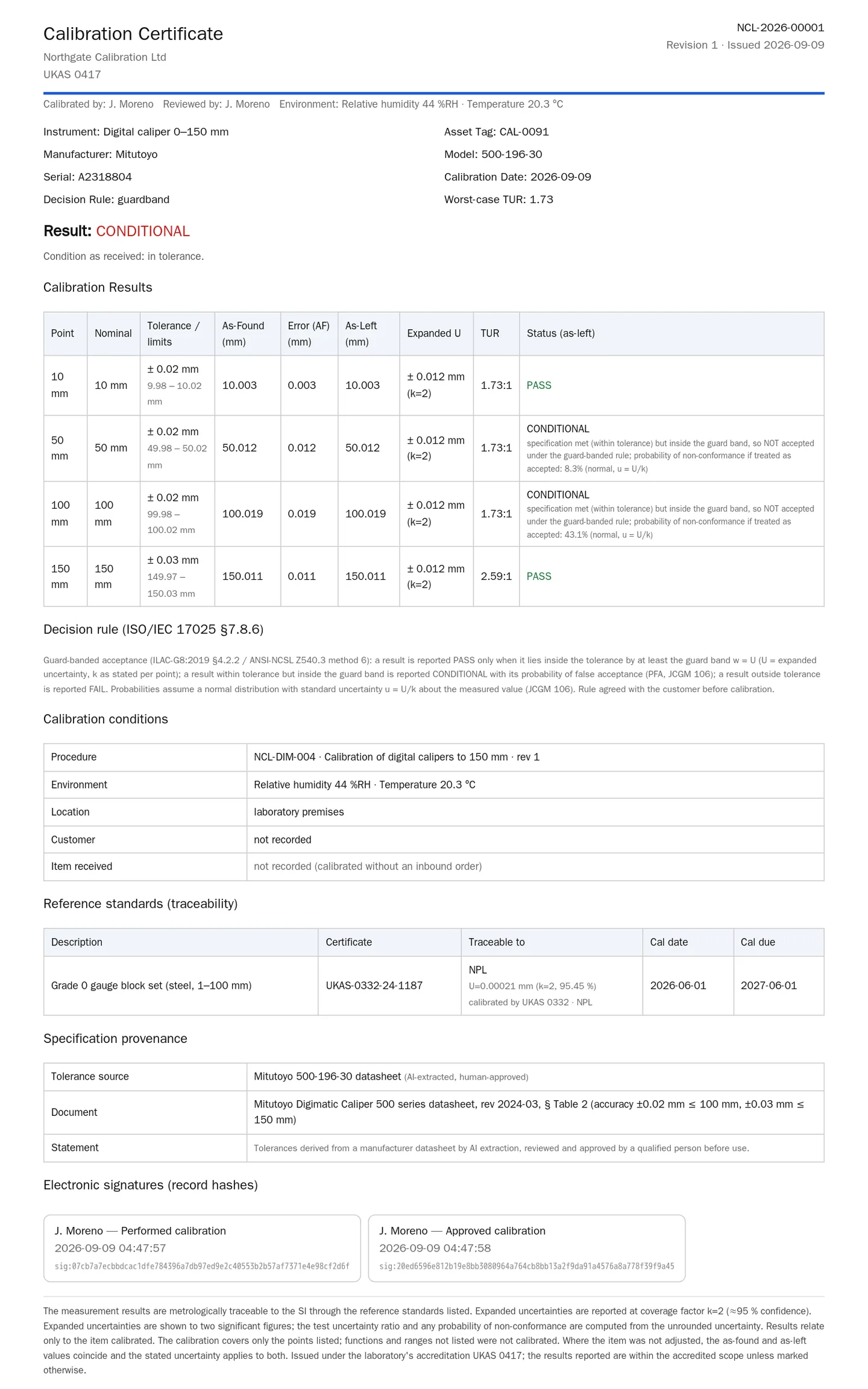
A rendered calibration certificate with standards, environment, decision rule and signatures
A certificate as the platform renders it: guard-band rule statement, U to two significant figures, standards with k and due dates, specification provenance, two signatures with hashes.
How it works

From the first record to the signed result

  1. 01
    Approve the event

    A certificate can only be issued from an approved calibration. One certificate per event; a second attempt returns the existing number.

  2. 02
    Number it

    The number comes from the tenant's prefix scheme, sequentially, audited.

  3. 03
    Render from the template

    Lab identity, accreditation number, signer name and title, per-customer template pinned by the service agreement.

  4. 04
    Print what the assessor needs

    Standards with their own certificates and due dates, environment in words, decision rule statement, TUR, tolerance limits and verdict per point, received date, procedure, scope and traceability statements.

  5. 05
    Export the DCC

    The same data as DCC XML with D-SI units, coverage factor and probability, influence conditions and conformity per result.

  6. 06
    Amend or revoke, never edit

    An amendment creates revision n+1 with the reason; the old revision stays. A revocation recalls. The verify page shows both.

What it includes · 21 capabilities

Everything in the module

Issue and render

  • Issue from an approved event; sequential numbering from the tenant prefix
  • HTML, PDF and DCC XML renders from one template shape
  • Values rounded to the significant figures of the uncertainty; results to U's decimal place
  • Decision-rule statement, coverage statement, scope statement, traceability statement, results-relate-only-to-the-item statement
  • Received date, condition on receipt and amendment history printed
  • Historical imported certificates render with a visible 'historical record — migrated' statement
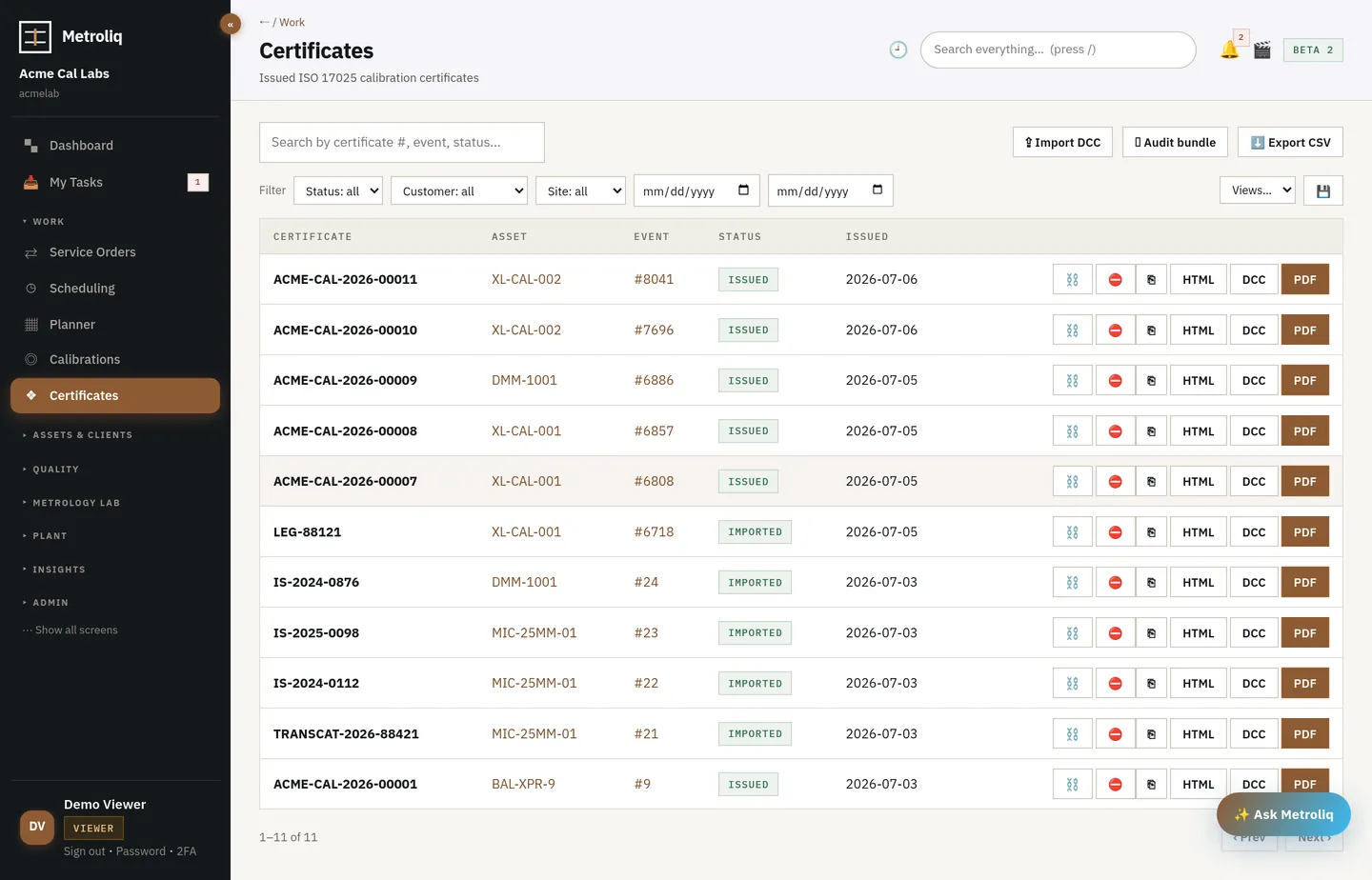
Certificate register with numbers, revisions and results
The certificate register: number, revision, result, and whether a newer revision supersedes it.

Digital Calibration Certificate

  • DCC XML export with administrative data, items, results, expanded uncertainty, coverage factor and probability, influence conditions
  • DCC import and parse with D-SI unit mapping; imported certificates land in the asset's history
  • Conformity per result carried into the DCC, including CONDITIONAL
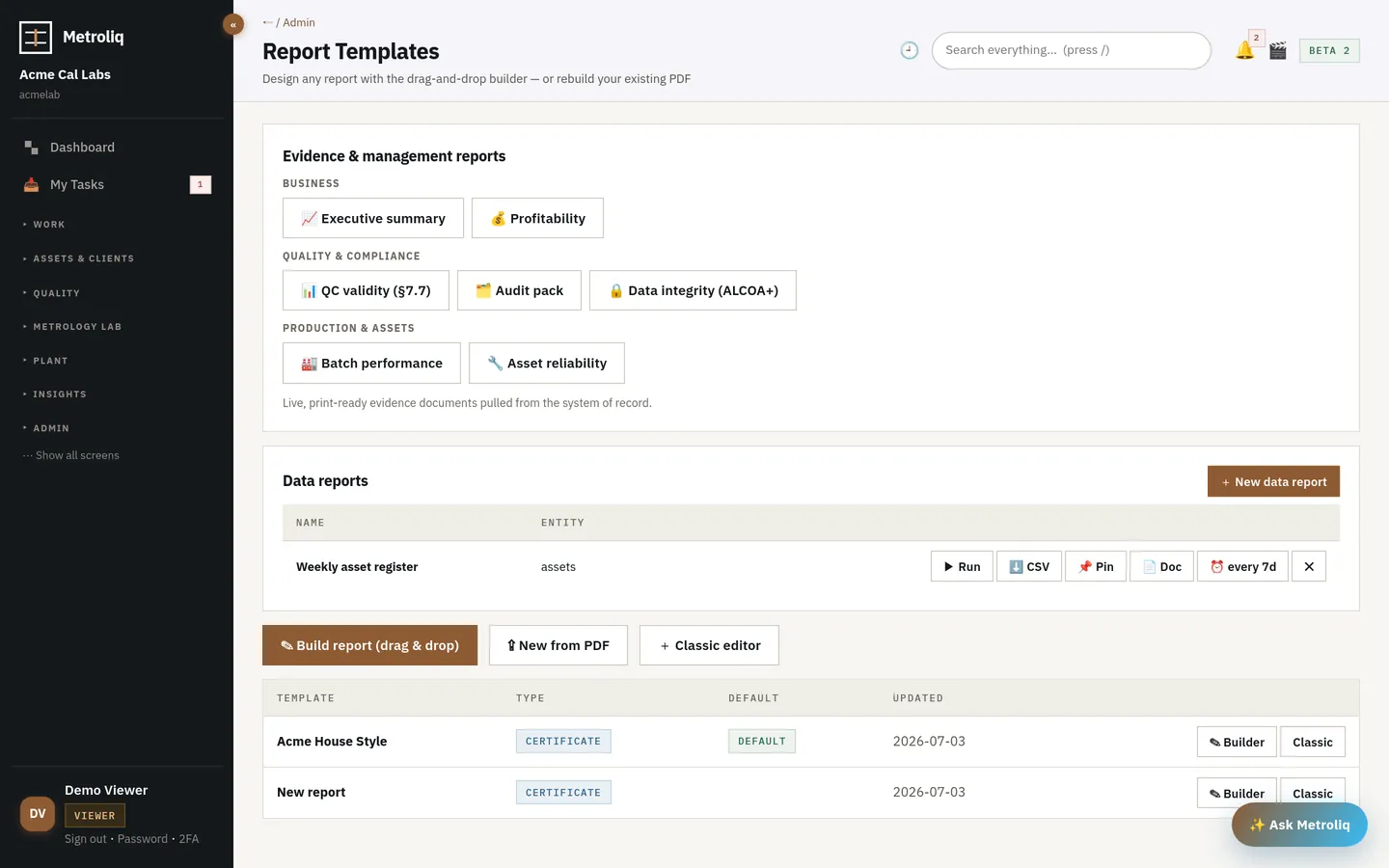
Drag-and-drop certificate template builder with live preview
The report builder: twelve block types bound to live record data, with a live preview. Or drop your old certificate PDF and the AI rebuilds it as a template.

Corrections and verification

  • Amendment (ISO/IEC 17025 §7.8.8) with reason; supersedes / superseded-by kept on both revisions
  • Revocation with reason
  • Public verify page: valid, superseded, revoked or under review; recommended recalibration date and in-date flag
  • Record hashes and electronic signatures listed on the certificate
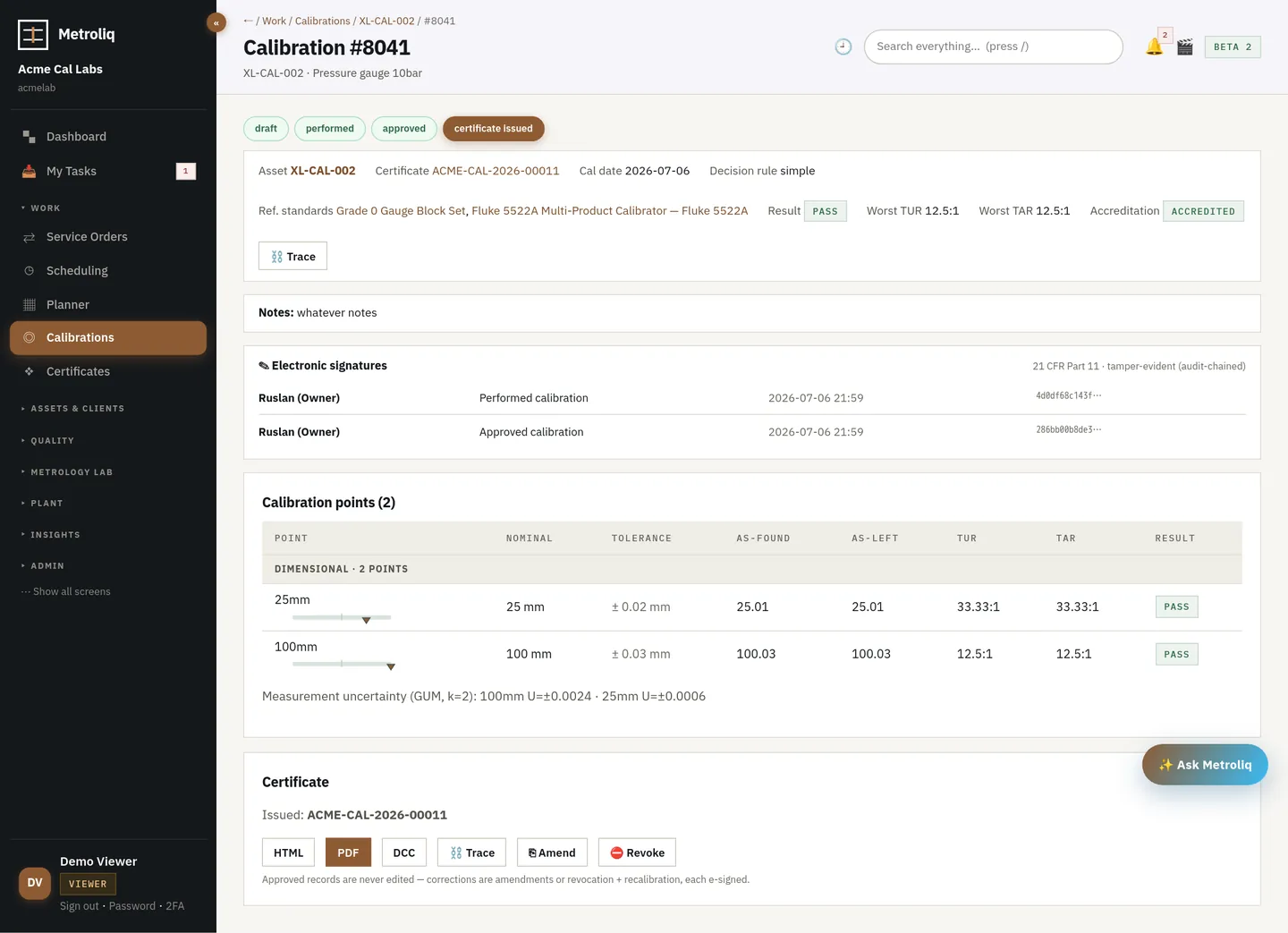
Approved calibration event with its issued certificate
An approved event and the certificate it issued; the two are one record, not a document attached to it.

Delivery

  • Certificate bundles and per-order certificate packages
  • CSV export of the register; QR label sheets
  • Customer notification on issue; a failed notification stays visible as a failed row
  • Report builder with twelve block types, live-data bindings, preview, and AI reconstruction of an old certificate layout
A rendered calibration certificate with standards, environment, decision rule and signatures
A certificate as the platform renders it: guard-band rule statement, U to two significant figures, standards with k and due dates, specification provenance, two signatures with hashes.

DCC validation & signing

  • Every DCC is validated against the official PTB DCC 3.2.0 and D-SI 2.1.0 schemas before it leaves the lab; several schema defects in the existing generator were found and fixed along the way.
  • DCC XML can be signed (XMLDSig, RSA-SHA256) and independently verified, with tampering detected; certificate PDFs get a detached CMS/PKCS#7 signature verifiable with standard tools.
  • The verification certificate is published at a well-known URL, and a lab can upload its own key and certificate so signed artefacts carry its identity; the certificate chain is disclosed as self-signed until a CA-issued one is uploaded.
  • Schema validation reports any XSD construct it could not evaluate as a warning with fully_checked=false instead of passing silently, and attribute values are checked; the subset validator is cross-checked in CI against libxml2 over a corpus of real and deliberately broken certificates.
Certificate register with numbers, revisions and results
In the product The certificate register: number, revision, result, and whether a newer revision supersedes it.
Guards the system enforces

Things it refuses to do

A quality system is defined as much by what it will not accept. These are enforced in the platform, not in a procedure.

refuses

Issue from an unapproved event

Refused (409).

refuses

Issue twice

The second attempt returns the existing certificate number rather than creating a duplicate.

refuses

Issue on a stale reference standard

Hard-blocked unless an override reason is supplied; the override is audited and visible.

refuses

Edit an issued certificate

There is no edit. Amend or revoke, with a reason, and every revision is kept.

Watch

Certificates & DCC in under a minute

Approved calibrations issue a numbered certificate rendered from your template — HTML, PDF and Digital Calibration Certificate XML from the same data — with the decision rule, the standards, the environment and the provenance printed on it.

Try it · Same record, two readers

The certificate a person reads and the one a machine imports.

Toggle between the printed certificate and its DCC XML. Both are generated from the same record — which is why they can't disagree.

Try it · certificate anatomy

Hover any part of a certificate. Read the clause it satisfies.

An annotated certificate as the platform prints it, mapped to ISO/IEC 17025 §7.8 and 21 CFR Part 11.

Drag-and-drop certificate template builder with live preview
In the product The report builder: twelve block types bound to live record data, with a live preview. Or drop your old certificate PDF and the AI rebuilds it as a template.
Why it's different

Compared with what is out there

Attachments

Quality-first suites treat certificates as attachments.

Here the certificate is a view of the data. Change the data and you get a new revision with a reason; you cannot get a certificate that says one thing while the record says another.

DCC

PDF-only tools stop where the customer's system starts.

The DCC lets the customer's asset system import the result, the uncertainty and the conformity without anyone retyping it — and Metroliq imports theirs the same way.

Honesty

Verification tells the truth.

CONDITIONAL, FAIL, superseded and revoked are shown on the public verify page. A certificate that looks cleaner than the data is not a certificate.
Beta · free while we build it with the first labs and plants

Bring one lab and your real history.

The tour runs the working platform, not a mockup. Pilot on your own instruments with your own imported history — we set it up with you, and fixes ship in hours and days, not release cycles.