metroliq
CalibrationCertificates & DCCQuality (QMS)Documents & trainingInstruments & captureSchedulingMaintenance (CMMS)Assets (EAM)Manufacturing (MES)Field serviceParts & inventoryService pipelineCustomer portalAI buildersIntegrations & APIComplianceWorkspace & admin
Maintenance · CMMS · condition monitoring

One asset. Its whole life.

Work orders with failure, cause and remedy codes, preventive maintenance by interval or meter, and condition-based rules that raise work from the readings the system already captures — all on the same asset spine as calibration. Labour timesheets, PO approval with three-way match, job-plan checklists with part reservations, cycle counts and LOTO permit-to-work now run inside the same work-order record. Weibull reliability fitted from real work orders and calibration history now drives an asset health score, remaining useful life and anomaly-triggered maintenance suggestions.

An ISO 14224-style controlled failure vocabulary means MTBF can be analysed by failure mode. A work order can require recalibration, and the calibration it triggers is on the same record. Parts consumed are drawn from lots with expiry. Warranty claims and recovery, FMECA with an RBI-style criticality band, capital projects tracked against budget, and a strategy library requiring a stated PM, condition-based or run-to-failure justification now sit on the same asset record.

See it in the tour Every capability
Timelines per asset1
PM triggersinterval · meter · condition
Codesfailure · cause · remedy
KPIsMTBF · MTTR · availability · TCO
In the product

What it looks like

Screens from the live platform, demo tenant. Click any screen to open it full size.
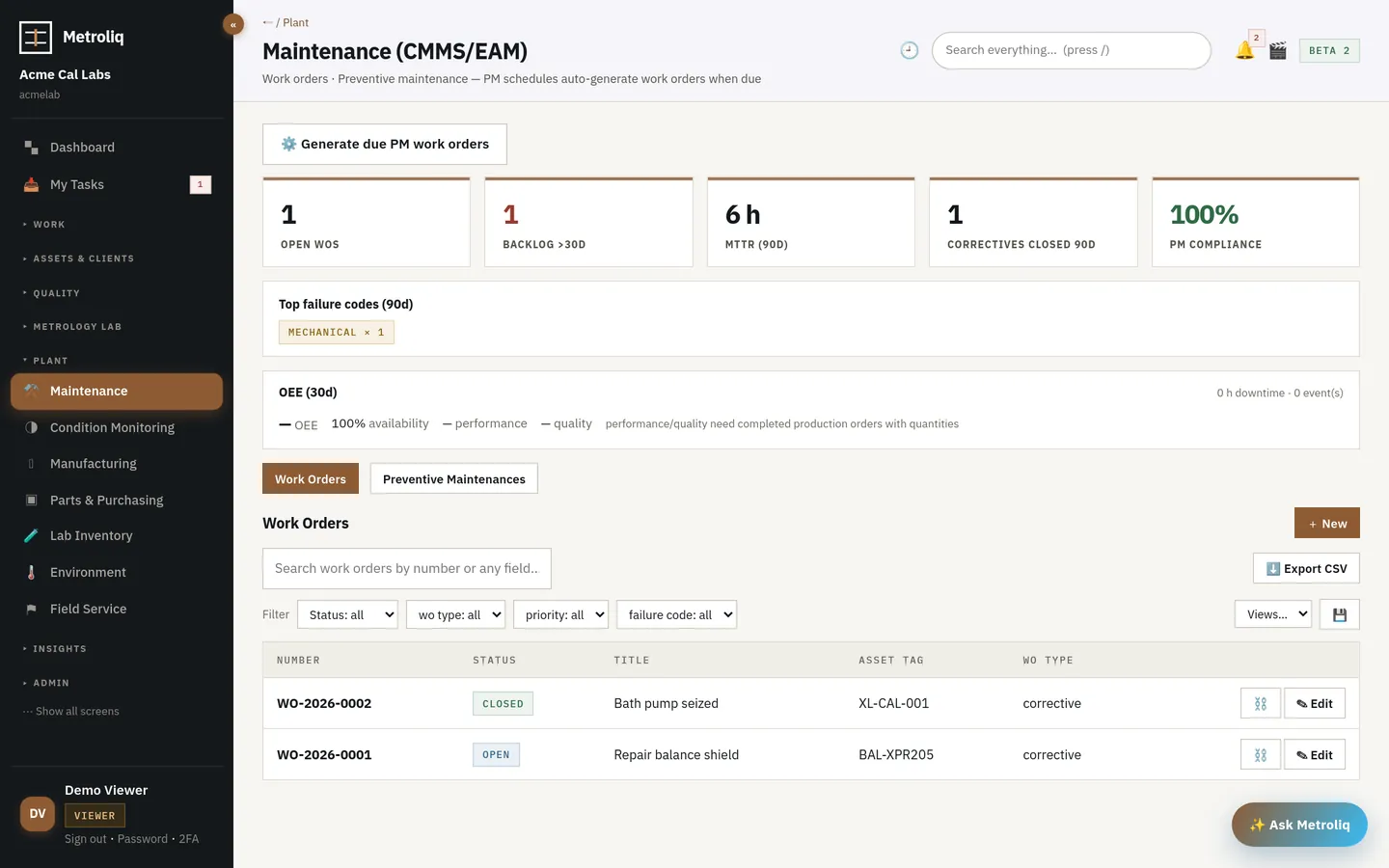
CMMS work orders with failure codes and status
Work orders with failure, cause and remedy codes, downtime and the PM they came from.
How it works

From the first record to the signed result

  1. 01
    Schedule

    Preventive maintenance by interval or by meter, generated automatically by the sweeper.

  2. 02
    Sense

    A condition rule on a meter raises a work order once per open occurrence.

  3. 03
    Work

    The work order carries codes, downtime, parts consumed and whether recalibration is required.

  4. 04
    Recalibrate

    If required, the calibration event is on the same asset with the work order as its cause.

  5. 05
    Analyse

    Reliability by failure mode, availability, TCO and EAM KPIs.

What it includes · 25 capabilities

Everything in the module

Work orders and PM

  • Work orders with failure, cause and remedy codes, downtime and requires-recalibration
  • PM schedules by interval or meter, generated automatically
  • Failure-code catalog (ISO 14224 style)
  • Maintenance history per asset
  • Work orders move one step at a time; corrective orders cannot close without failure and remedy codes and labour hours
  • PM generation skips retired and out-of-service assets and reports what it skipped
  • Condition-based rules are tenant-validated and failures are logged, never swallowed
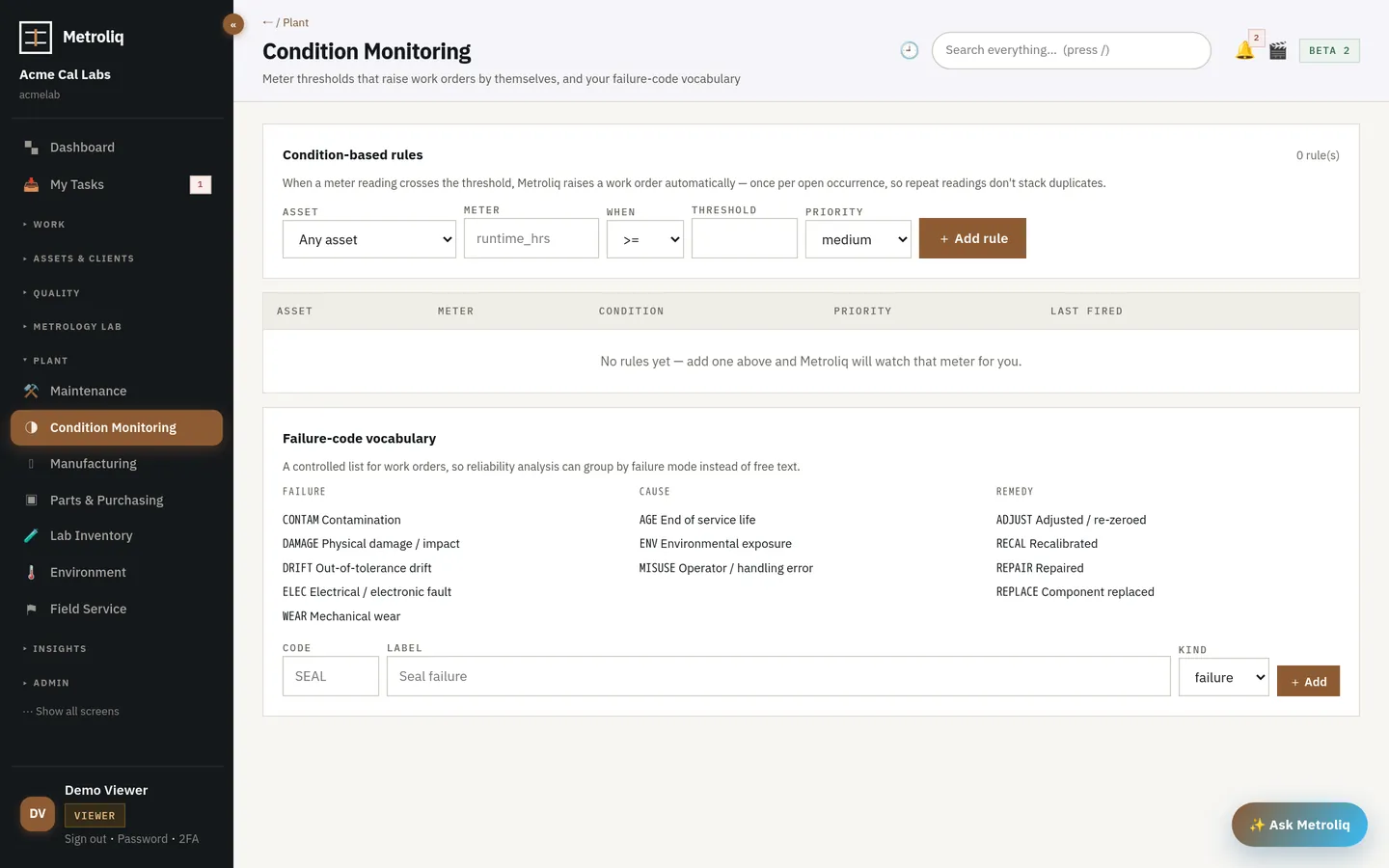
Condition-based maintenance rules and failure codes
Condition-based rules on a named meter or condition, and the failure-code catalog.

Condition monitoring

  • Asset meters and meter readings
  • Condition-based rules raising a work order once per open occurrence
  • Environment and instrument readings usable as conditions
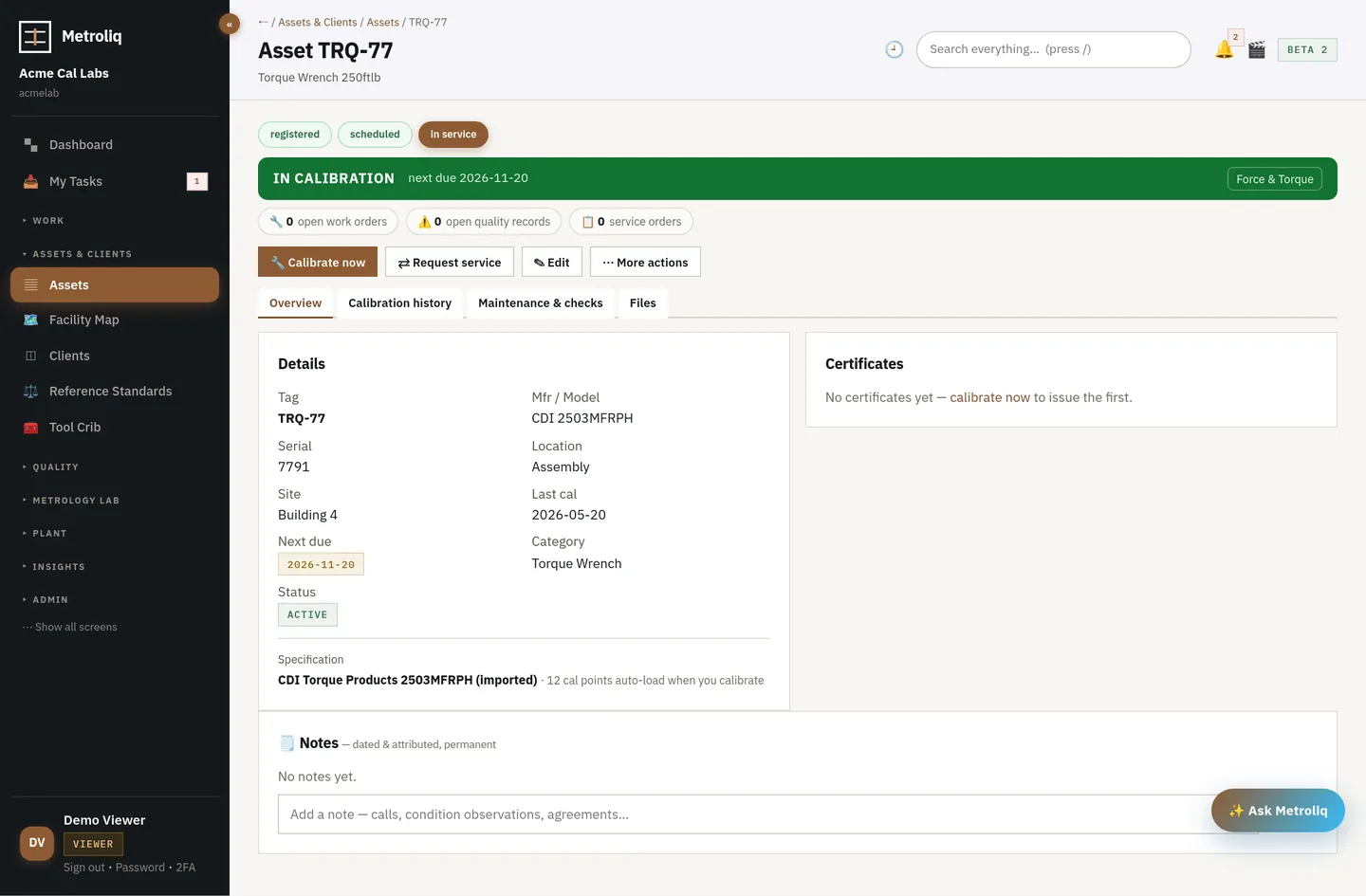
Asset page with maintenance and calibration history in one timeline
An asset: calibrations, work orders, parts, documents and logbook in one timeline.

Analysis

  • Asset reliability report by failure mode
  • EAM KPIs, availability, total cost of ownership
  • Parts consumption against the work order
CMMS work orders with failure codes and status
Work orders with failure, cause and remedy codes, downtime and the PM they came from.

Labour, purchasing & permits

  • Labour time: clock-in/out, manual entries, supervisor approval that locks entries, weekly timesheets, payroll CSV, craft-rate snapshots rolled into work-order cost
  • Purchasing controls: requisition → approval with role-based limits → PO, RFQ with multi-vendor comparison, three-way match of PO, receipt and invoice with a configurable tolerance
  • Job plans copy a task checklist onto a work order, reserve parts (on hand minus reserved) and gate completion on the checklist
  • Cycle counts with e-signature above a variance threshold posting stock adjustments on approval; ABC classification and reorder points from stock-move history; storeroom transfers; serialised spares
  • LOTO and permit-to-work (draft → issued → active → closed, e-signed) that blocks a work order from starting without an active permit and from closing while one is open; printable permit PDF
  • Downtime reasons (planned/unplanned) rolled into MTBF/MTTR by asset class and schedule-compliance KPIs
Condition-based maintenance rules and failure codes
Condition-based rules on a named meter or condition, and the failure-code catalog.

Predictive maintenance

  • Weibull reliability per asset class fitted two ways (maximum likelihood with censoring and median-rank regression) from real corrective work orders and failed or conditional calibrations; B10/B50 life, hazard curves, MTBF/MTTR trends with control limits.
  • Asset health score (0–100) from age against the fitted distribution, open exceptions, overdue PM or calibration, drift and live anomaly signals; remaining useful life from conditional survival.
  • Edge-sensor anomaly detection (rolling z-score, EWMA, Westgard rules, seasonal baseline) raises a reviewable suggestion, never an automatic work order.
  • PM-interval cost optimiser once the lab supplies its own PM and failure costs.
Asset page with maintenance and calibration history in one timeline
An asset: calibrations, work orders, parts, documents and logbook in one timeline.

Warranty, FMECA & strategy

  • Warranty tracking with claims and recovery, FMECA with an RBI-style criticality band, capital projects with budget versus actual, and a strategy library that requires a stated PM, condition-based or run-to-failure justification per asset class.
CMMS work orders with failure codes and status
Work orders with failure, cause and remedy codes, downtime and the PM they came from.

Spatial & linear assets

  • GeoJSON layers rendered as inline SVG (no map library, tiles or PostGIS), linear-referenced pipe/cable/fence segments resolved to coordinates, a configurable 0–100 condition index, replacement-priority ranking with a plain-English reason per asset, and a mobile-first map-guided inspection-route runner with photo-annotated defect capture.
Condition-based maintenance rules and failure codes
In the product Condition-based rules on a named meter or condition, and the failure-code catalog.
Watch

Maintenance (CMMS) in under a minute

Work orders with failure, cause and remedy codes, preventive maintenance by interval or meter, and condition-based rules that raise work from the readings the system already captures — all on the same asset spine as calibration. Labour timesheets, PO approval with three-way match, job-plan checklists with part reservations, cycle counts and LOTO permit-to-work now run inside the same work-order record. Weibull reliability fitted from real work orders and calibration history now drives an asset health score, remaining useful life and anomaly-triggered maintenance suggestions.

Asset page with maintenance and calibration history in one timeline
In the product An asset: calibrations, work orders, parts, documents and logbook in one timeline.
Why it's different

Compared with what is out there

Seam

Maintenance-first suites don't see calibration.

And calibration tools don't see maintenance. Here it is one record, so the auditor's question — what happened to this asset — is one page.

Instrument

Condition rules use readings the system already has.

No separate sensor platform to integrate: the meters and environment readings the lab captures drive the rules.
Beta · free while we build it with the first labs and plants

Bring one lab and your real history.

The tour runs the working platform, not a mockup. Pilot on your own instruments with your own imported history — we set it up with you, and fixes ship in hours and days, not release cycles.