metroliq
CalibrationCertificates & DCCQuality (QMS)Documents & trainingInstruments & captureSchedulingMaintenance (CMMS)Assets (EAM)Manufacturing (MES)Field serviceParts & inventoryService pipelineCustomer portalAI buildersIntegrations & APIComplianceWorkspace & admin
Scheduling · intervals · planner

Intervals that follow the evidence.

A twelve-month workload forecast, an interval review that measures how much tolerance each asset actually consumed and which way it drifts, and a recommendation to shorten, keep or extend — on deterministic, auditor-defensible arithmetic.

The AI drafts a week-by-week work plan as narrative; the maths stays deterministic. A drag-and-drop planner assigns technician by day. Due orders and customer due notices are generated automatically, service cycles recur, and the schedule is available as an ICS calendar feed. Multi-week capacity planning checks real due workload against technicians, benches and standards, with what-if hire, overtime or outsource scenarios and skill-gap detection.

See it in the tour Every capability
Interval basisas-found history
Forecast12 months
MethodILAC-G24 / RP-1
Changee-signed + justified
In the product

What it looks like

Screens from the live platform, demo tenant. Click any screen to open it full size.
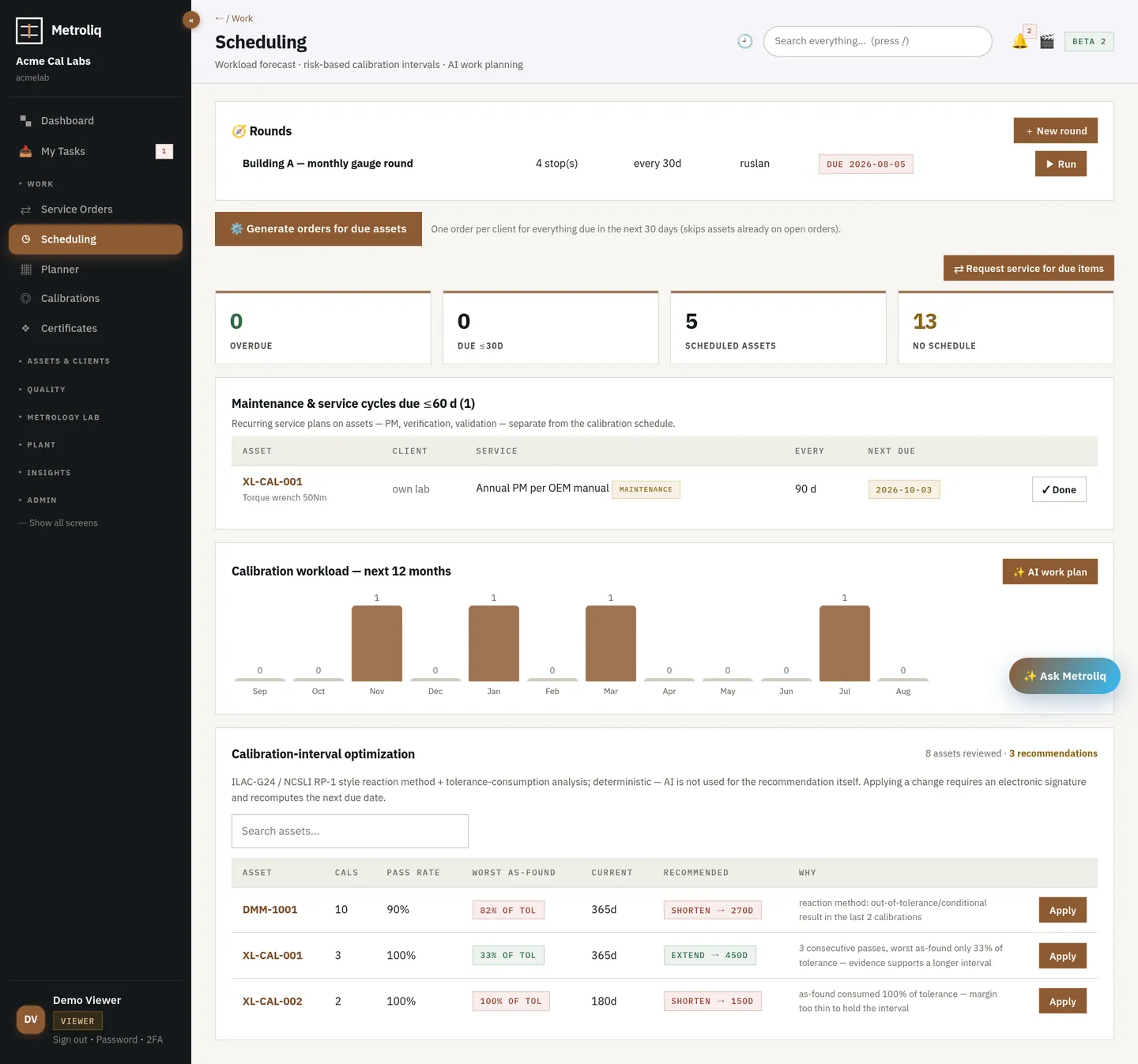
Twelve-month workload forecast and interval review
Workload forecast and interval review: tolerance consumed, drift direction, recommendation.
How it works

From the first record to the signed result

  1. 01
    Forecast

    Twelve months of workload and the overdue backlog, by site and customer.

  2. 02
    Review intervals

    Per asset: tolerance consumed at as-found, drift direction, recommendation.

  3. 03
    Accept with a signature

    An interval change is e-signed and justified on the record.

  4. 04
    Plan

    AI-drafted weekly plan; the planner assigns technicians.

  5. 05
    Generate work

    Due orders, quote chasing, customer due notices and service cycles run on the automation sweeper.

What it includes · 13 capabilities

Everything in the module

Forecast and intervals

  • Twelve-month workload forecast and overdue backlog
  • Per-asset interval review in the ILAC-G24 / NCSLI RP-1 reaction-method style
  • Interval change with e-signature and justification
  • AI-drafted week-by-week work plan (narrative only)
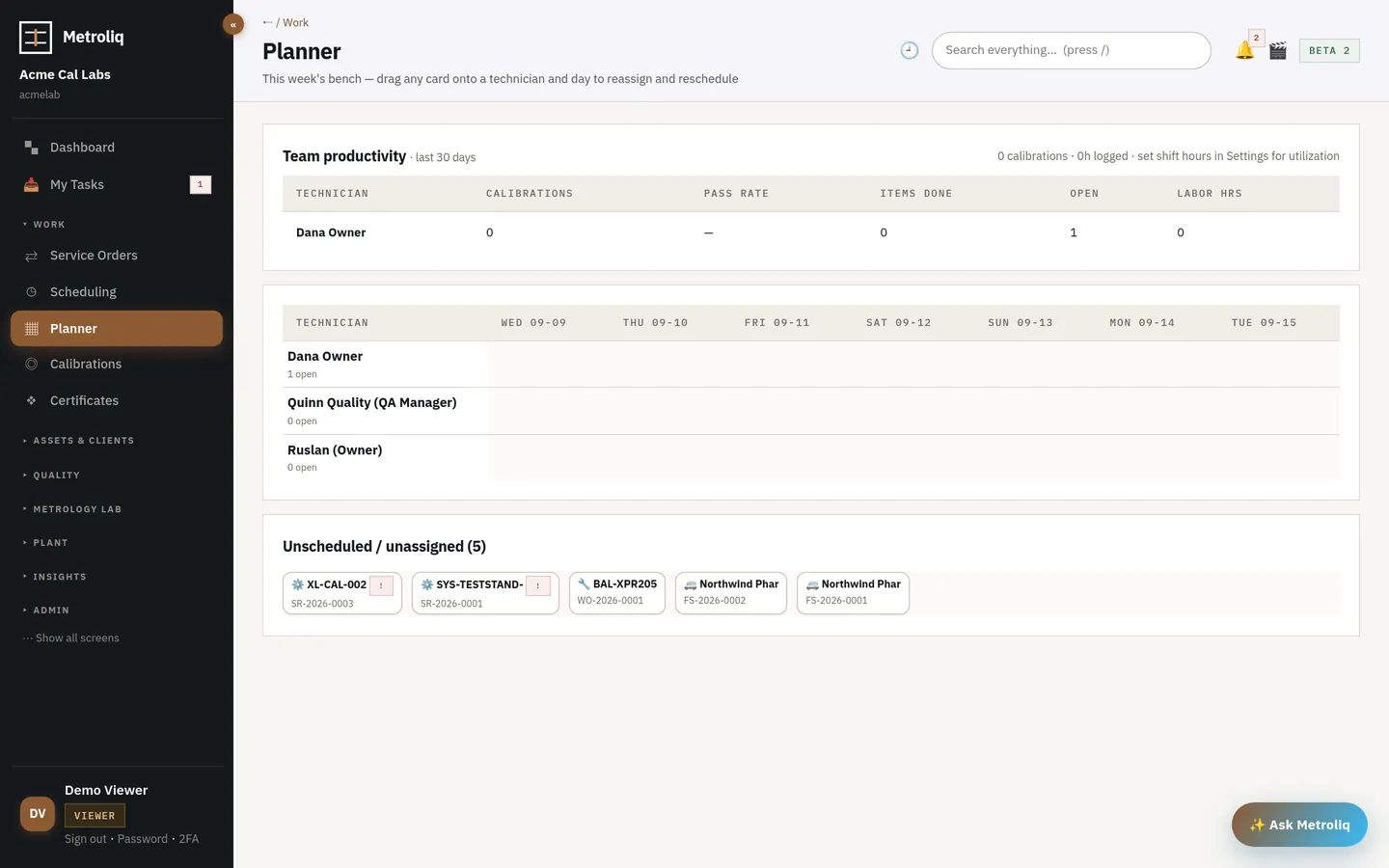
Drag and drop technician by day planner
The planner: technician × day, drag and drop.

Planning and generation

  • Drag-and-drop technician × day planner
  • Due-order generation and quote chasing
  • Customer due notices
  • Service cycles with due list
  • ICS calendar feed
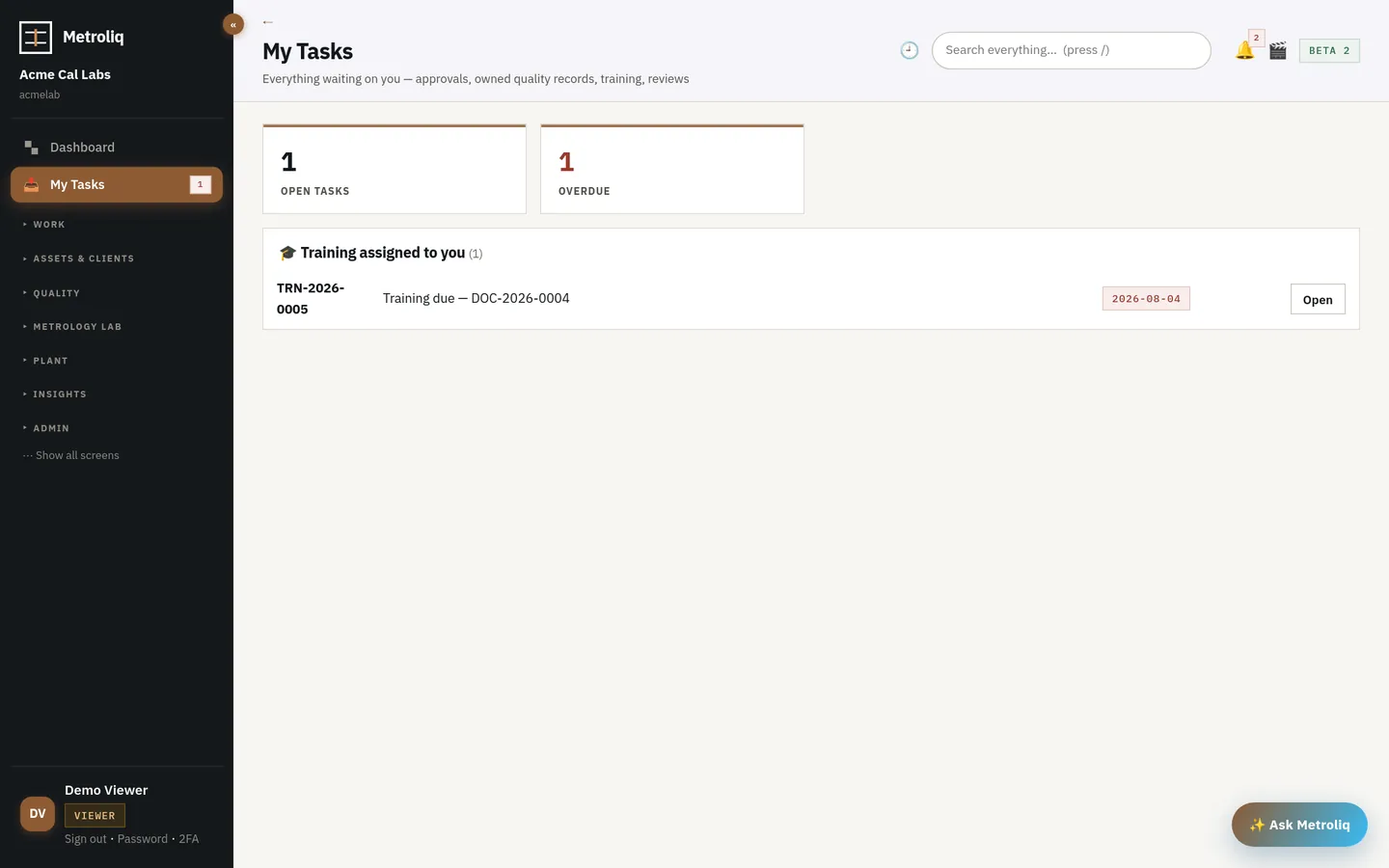
Technician task list
A technician's day: what is due, what is assigned, what is waiting on a signature.

Capacity planning

  • Multi-week capacity planning from real due workload (calibrations, PM, field jobs, work and production orders) against technicians, benches and standards; what-if hire, overtime or outsource scenarios; skill-gap detection.
Twelve-month workload forecast and interval review
Workload forecast and interval review: tolerance consumed, drift direction, recommendation.

Finite-capacity planning

  • Deterministic finite-capacity scheduler assigns technicians, benches and reference standards to real due work from six sources (calibrations, PMs, work orders, production orders, field jobs, lab order lines) under hard constraints (calendars, skills and §6.2.5 authorization, bench kind, standard availability, parts, no double-booking, planner locks); every unscheduled item carries a named reason and a fix suggestion; explainable Gantt with per-assignment rationale; apply is idempotent and never overwrites a record changed since the run. Not a proven-optimal solver and says so.
  • Applying a plan checks each target against the state the solve actually saw. A work order, field job or order line changed by someone else since the run is skipped with a named reason rather than silently overwritten.
  • The improvement phase is iteration-bounded rather than wall-clock bounded, so the same inputs produce the same schedule on any machine, and ties are broken by a seeded generator rather than by whichever row was read first.
Drag and drop technician by day planner
In the product The planner: technician × day, drag and drop.
Watch

Scheduling & intervals in under a minute

A twelve-month workload forecast, an interval review that measures how much tolerance each asset actually consumed and which way it drifts, and a recommendation to shorten, keep or extend — on deterministic, auditor-defensible arithmetic.

Try it · Interval from drift

How much tolerance does the interval consume?

Move the drift and the interval. The suggestion keeps the projected drift inside the tolerance with the allowed risk margin — the logic behind the interval review.

Technician task list
In the product A technician's day: what is due, what is assigned, what is waiting on a signature.
Why it's different

Compared with what is out there

Calendar

Maintenance-first suites schedule by calendar.

Here the interval is tied to how the instrument actually behaved — its as-found history and drift — and a change is a signed, justified act.

Narrative

The AI plans; it does not calculate.

The work plan is narrative for a person to accept. The interval maths is deterministic and reproducible.
Beta · free while we build it with the first labs and plants

Bring one lab and your real history.

The tour runs the working platform, not a mockup. Pilot on your own instruments with your own imported history — we set it up with you, and fixes ship in hours and days, not release cycles.