In the product
What it looks like
Screens from the live platform, demo tenant. Click any screen to open it full size.
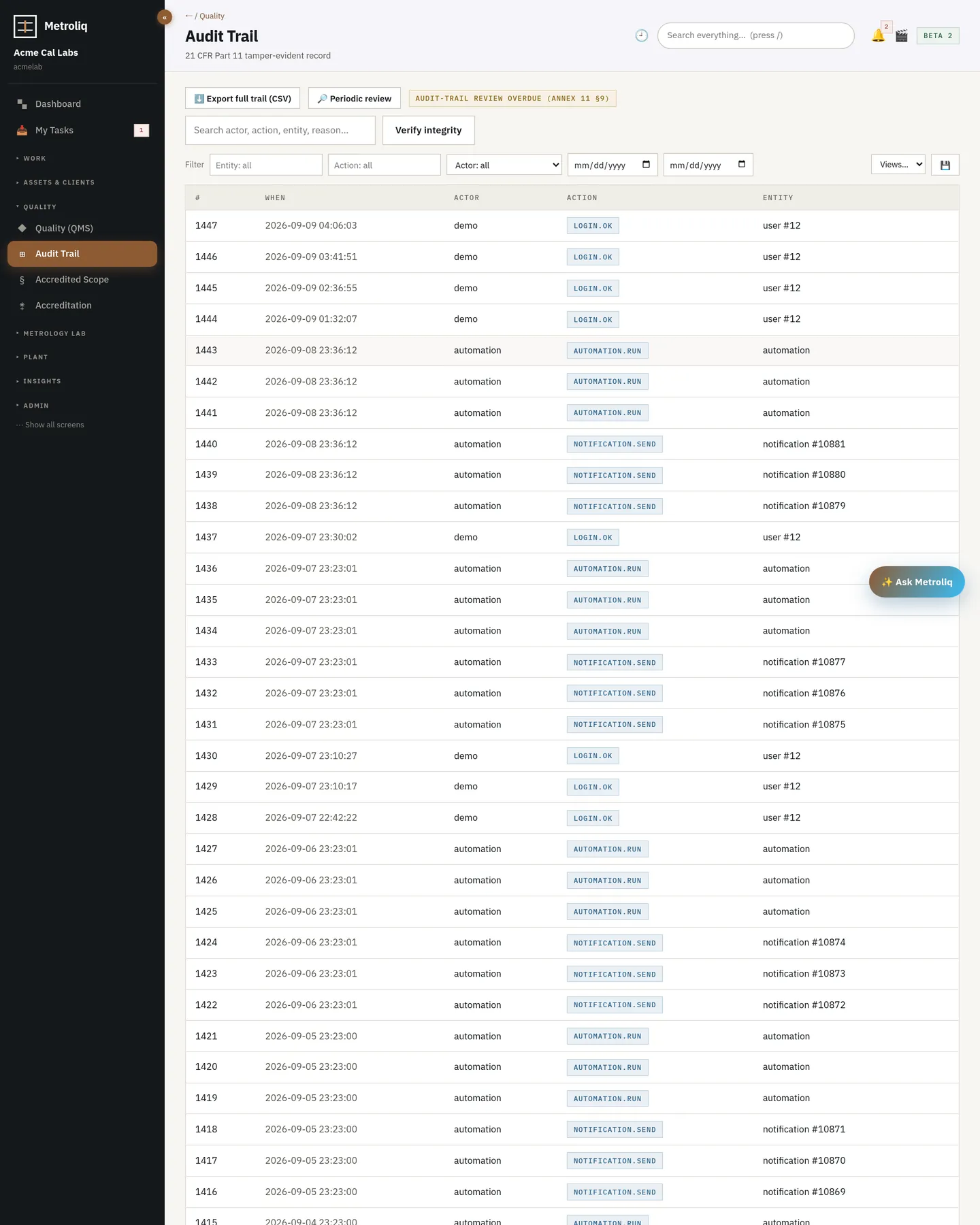
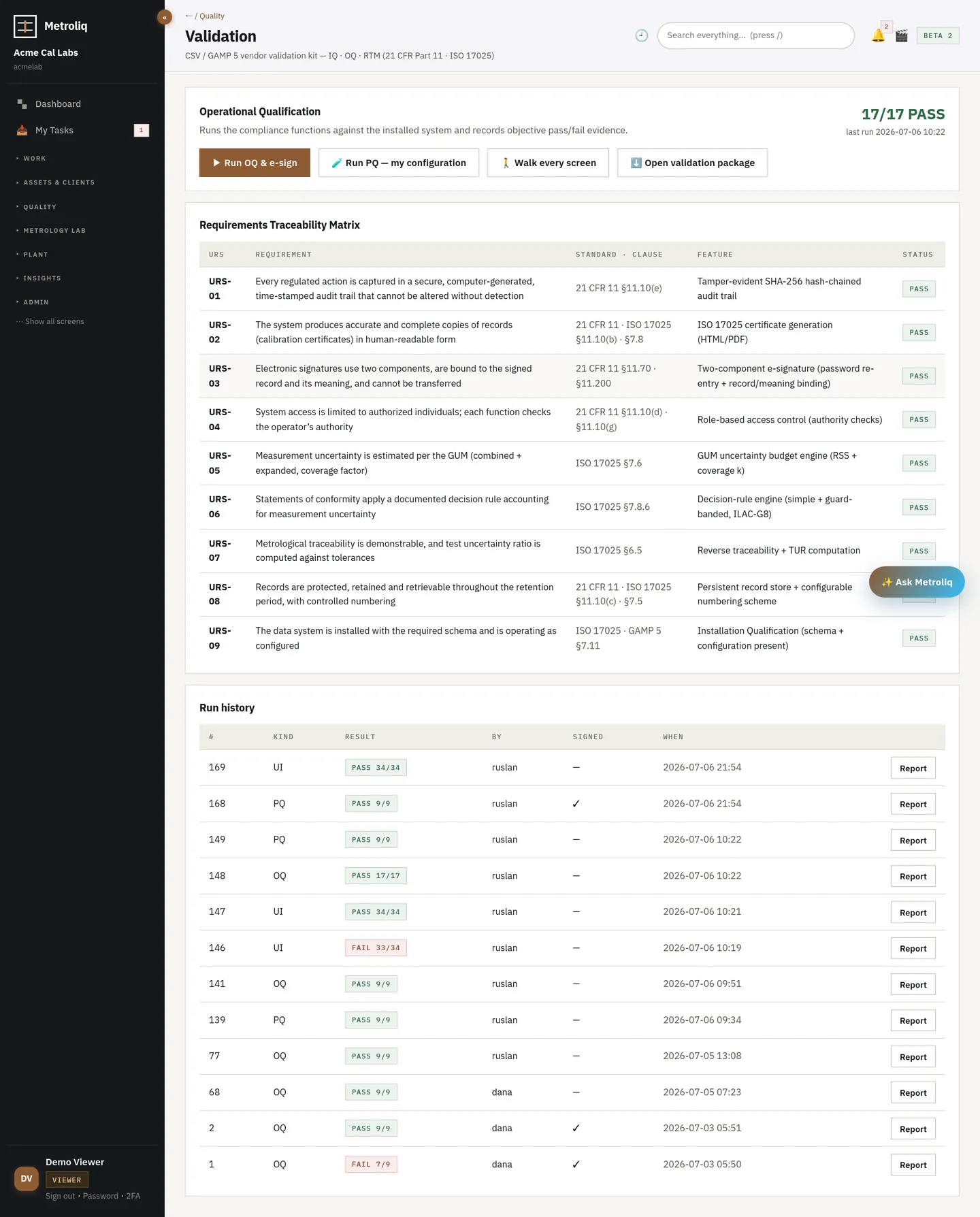
ISO/IEC 17025:2017 and 21 CFR Part 11 are not features bolted on; they are how the record works: a SHA-256 hash-chained audit trail, two-component electronic signatures bound to meaning, independent approval, supplier validation evidence — our FS, IQ, self-running OQ and test reports — plus your own PQ, retention policies and legal holds, SSO, SCIM and 2FA. Security headers, a tuned content-security policy, per-IP-and-tenant rate limiting and tightened request-size limits harden the API and web app, with a live headers-check endpoint for review.
What the platform is built to satisfy: ISO/IEC 17025:2017 (§6.2.5 authorization, §7.8 reporting incl. §7.8.8 amendments), 21 CFR Part 11 electronic records and signatures, ILAC-P14 uncertainty reporting, ILAC-G8 decision rules, ILAC-G24 intervals, JCGM 100 / 101 / 106, ANSI/NCSL Z540.3, AIAG MSA, ISO 14224 failure vocabulary, DCC for digital certificates, and the GAMP-style validation approach used by regulated manufacturers (ISO 13485, ISO 9001 quality systems). Per-tenant AI governance with redaction and an evidence registry, a two-step e-signed GDPR erasure workflow, an accessibility pass to zero axe violations on the busiest screens, and automated ZAP/npm-audit scan evidence mapped to a SOC 2 / ISO 27001 controls matrix now back the same compliance record. Every release now carries a computed impact report and validated-upgrade pack, audit trails can stream to a SIEM or syslog collector, and the security baseline adds an SBOM, dependency-vulnerability, static-analysis and secrets scan alongside certificate-expiry alerts.
Screens from the live platform, demo tenant. Click any screen to open it full size.
Canonical serialization, SHA-256, each entry hashing the previous. Edit history and the chain breaks visibly.
Password as signature, two components, bound to the meaning of the act (performed, approved, reviewed). An optional signing session of up to 30 minutes, or a password every time.
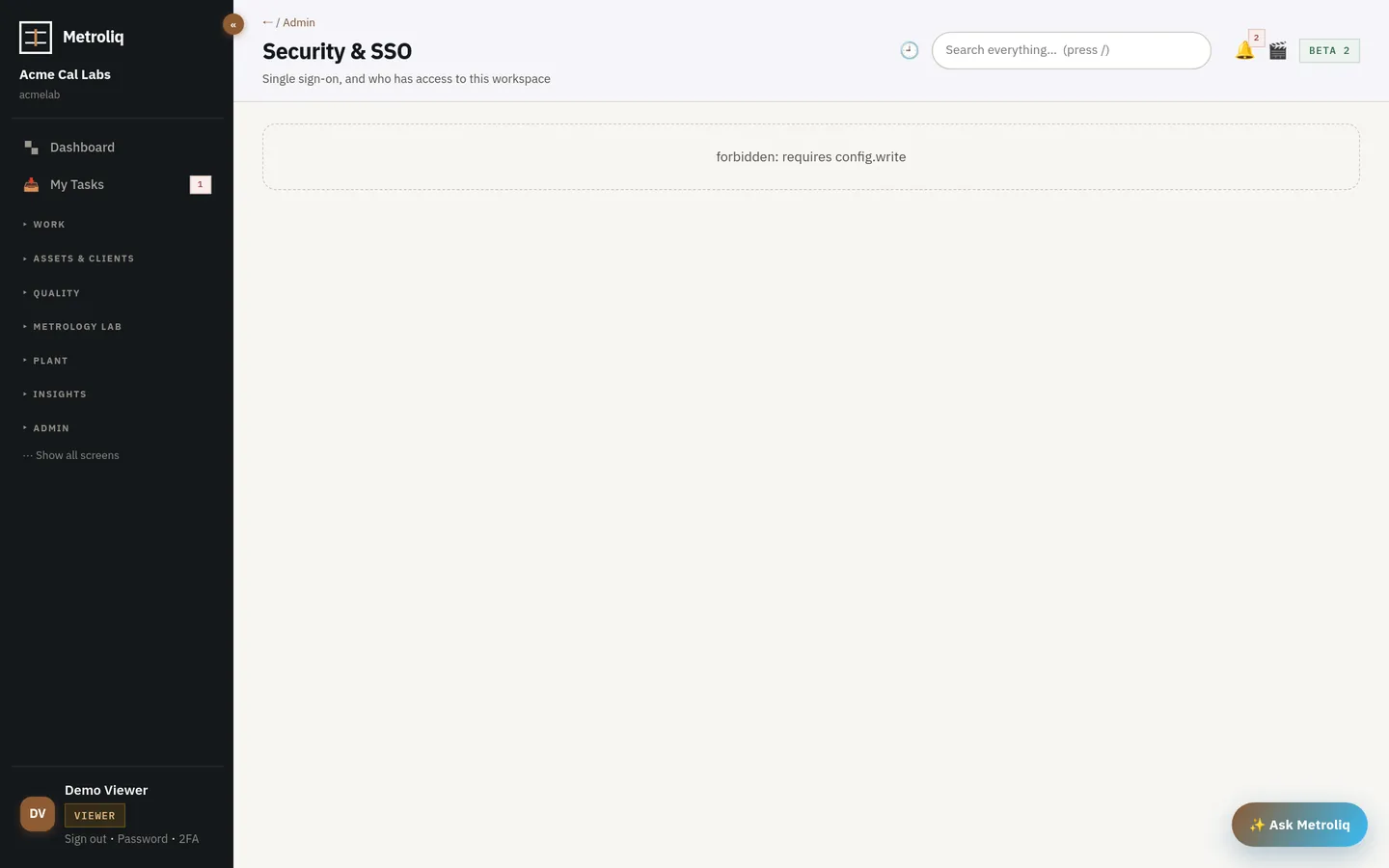
Custom roles with granular permissions; independent approval; discipline authorization; access review.
Certificates are amended or revoked, never edited. Signed records that are edited have their signatures rescinded, and the rescission is audited.
Requirements traceability, IQ, a self-running OQ that produces and signs its own evidence, PQ, and a UI walk. Re-run after every change.
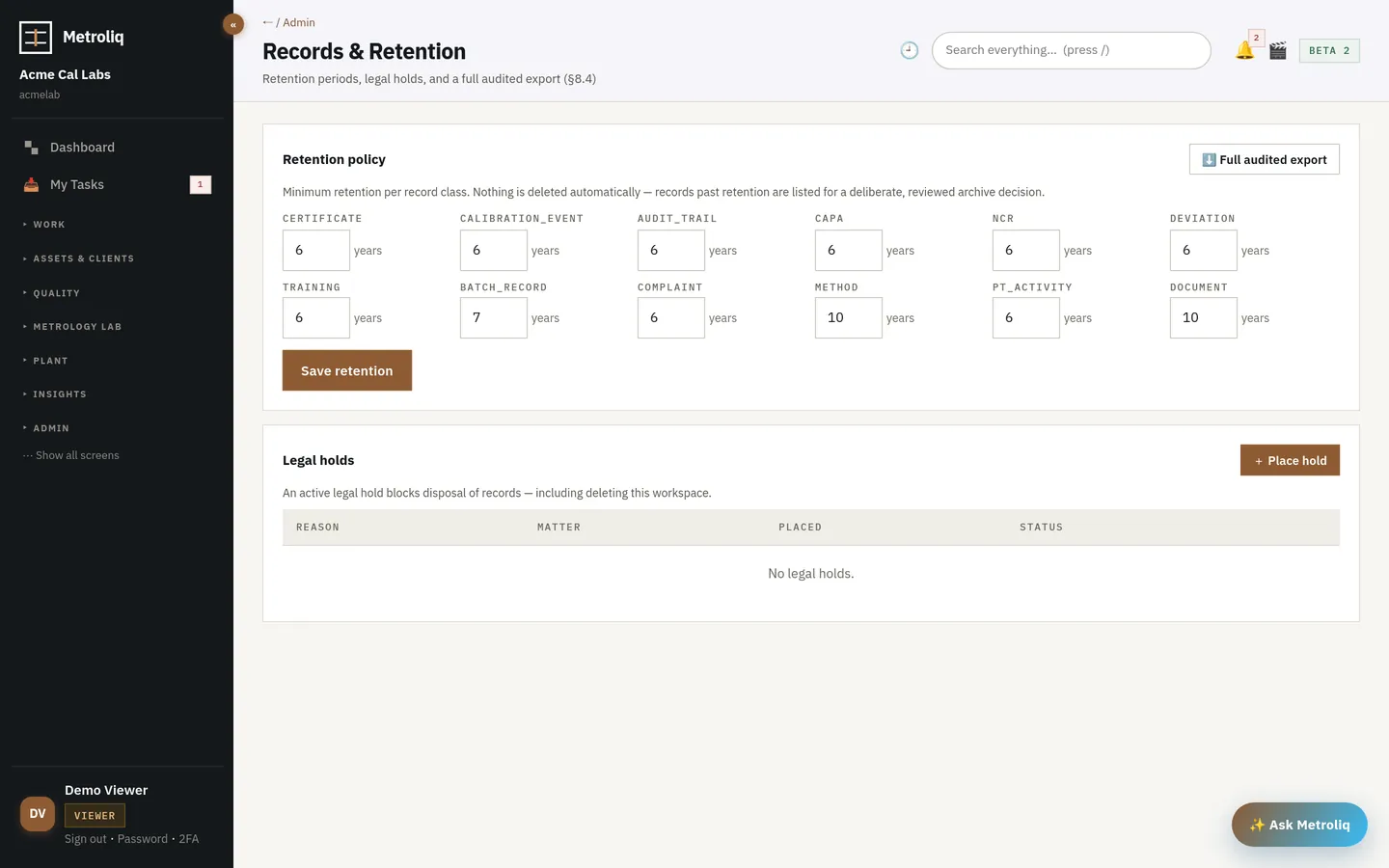
Retention policy per record class, legal holds, audited export. Nothing auto-deletes.
A quality system is defined as much by what it will not accept. These are enforced in the platform, not in a procedure.
Never. Every AI output is a draft until a person signs.
Records follow retention policy and legal holds; nothing auto-deletes.
Refused (409).
The signatures are rescinded and the rescission is audited.
ISO/IEC 17025:2017 and 21 CFR Part 11 are not features bolted on; they are how the record works: a SHA-256 hash-chained audit trail, two-component electronic signatures bound to meaning, independent approval, supplier validation evidence — our FS, IQ, self-running OQ and test reports — plus your own PQ, retention policies and legal holds, SSO, SCIM and 2FA. Security headers, a tuned content-security policy, per-IP-and-tenant rate limiting and tightened request-size limits harden the API and web app, with a live headers-check endpoint for review.
The hash chain, the signatures and the verdict logic are the same code in the app, the certificate and the DCC.
Instead of a binder of screenshots, the operational qualification executes the checks, records the evidence and signs it — and you can re-run it after every change in hours, not weeks.
Features ship in hours and days; the audit trail, signatures and certificate revisions are immutable by construction.
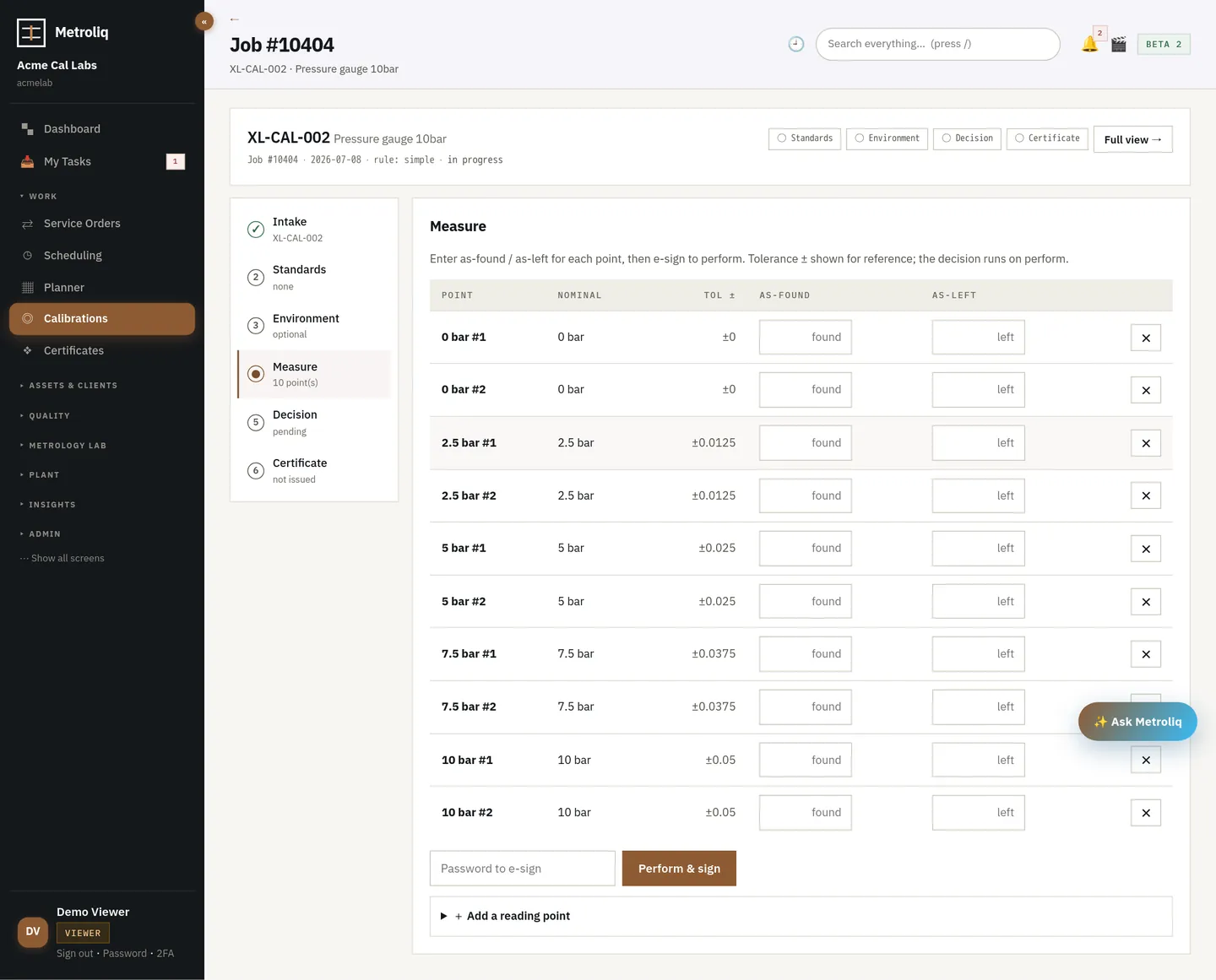 Calibration & uncertaintyCalibration & uncertaintyThe verdict is computed, not typed.Every calibration is a numbered event that carries its own points, readings, reference standards, environment and decision rule — and evalua…
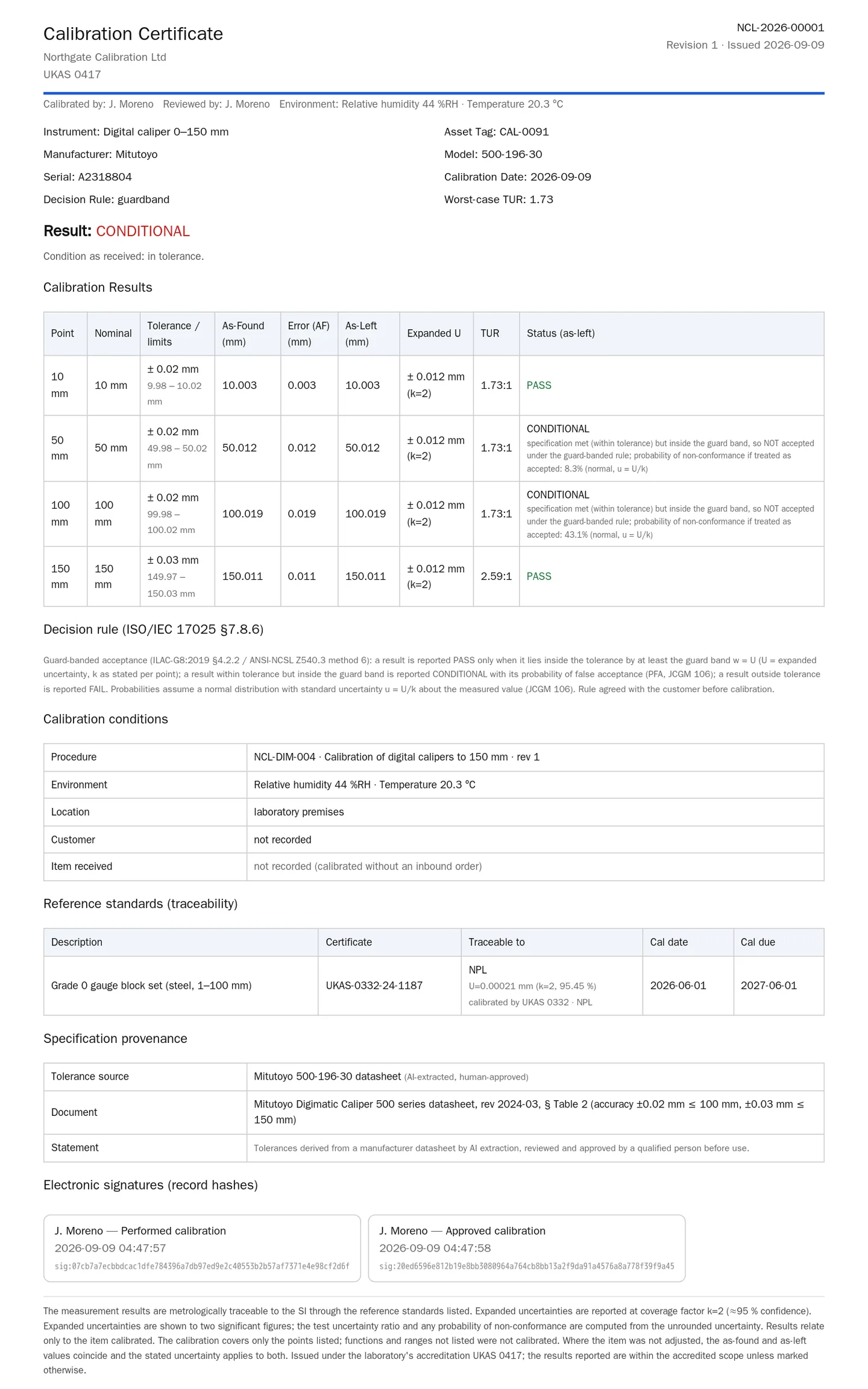 Certificates & DCCCertificates & DCCOne record. A PDF a person reads, a DCC a machine imports.Approved calibrations issue a numbered certificate rendered from your template — HTML, PDF and Digital Calibration Certificate XML from the …
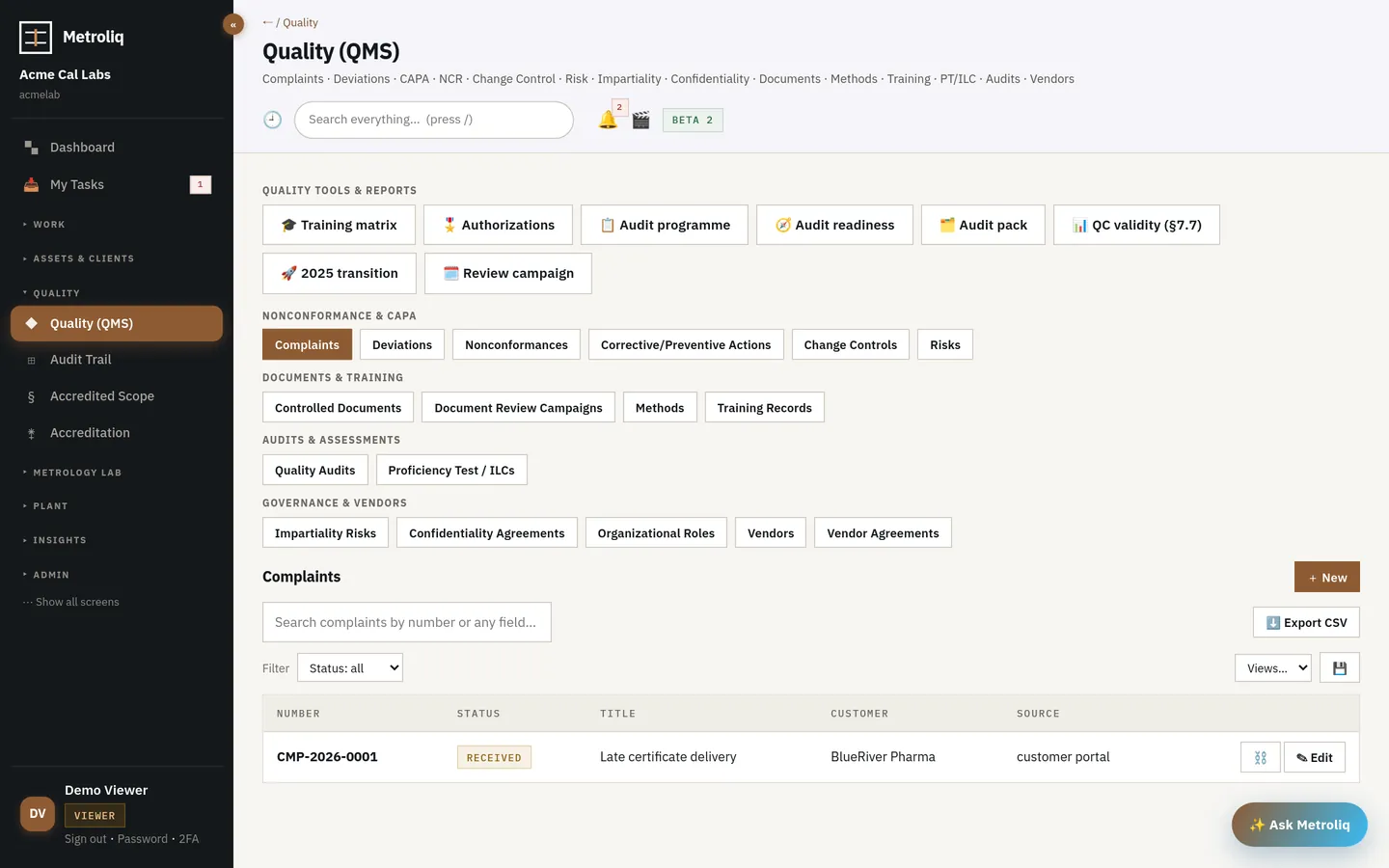 Quality management · QMSQuality management (QMS)A deviation the system can explain.CAPA, NCR, deviations, complaints, controlled documents, training, audits, risks, change control, vendors, methods, proficiency testing — on…
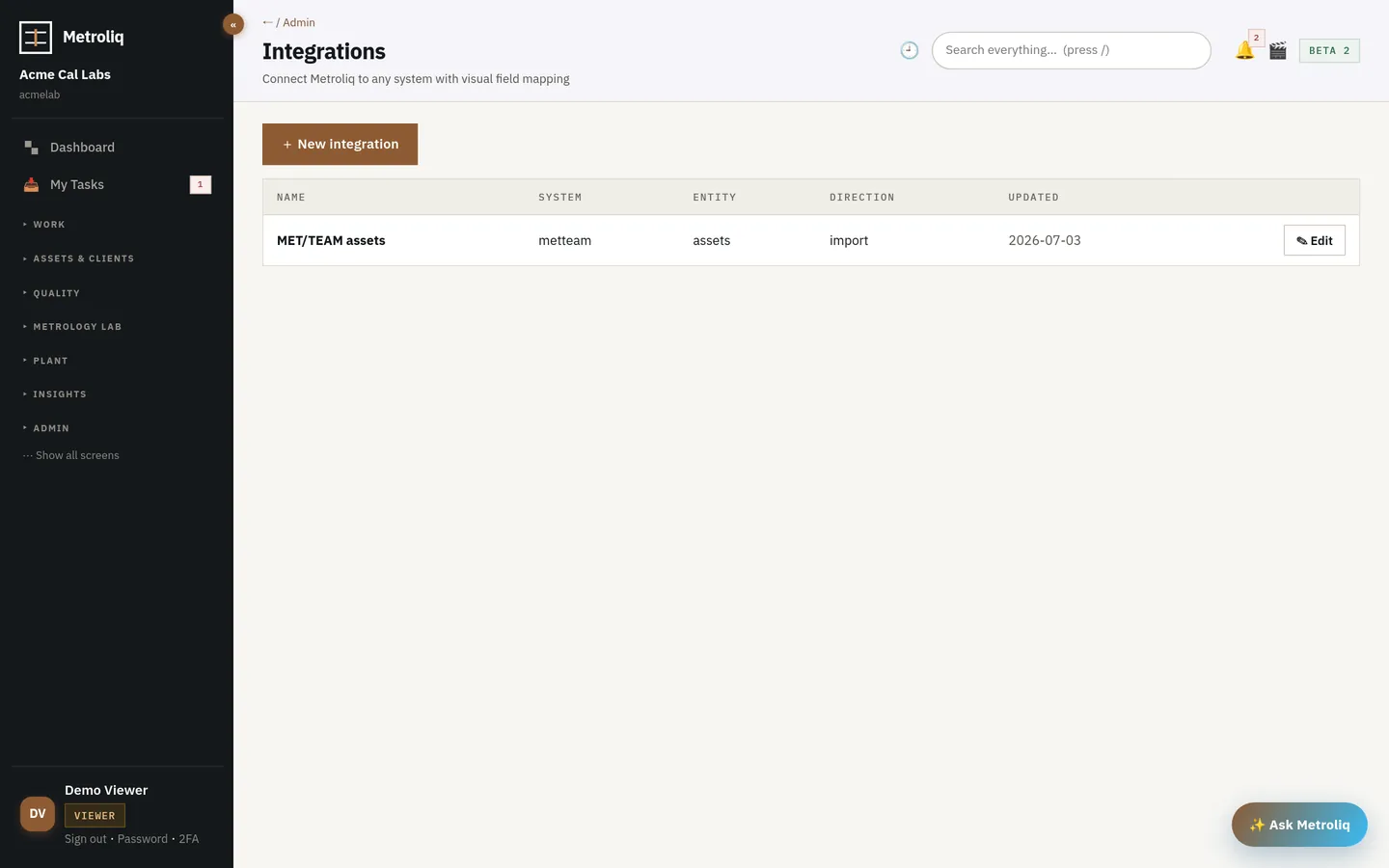 Integrations · API · automationIntegrations, API & automationConfigured, never hard-coded.A visual integration builder with a ten-system catalog plus generic REST and CSV, AI-proposed field mapping with a dry run, signed webhooks …
The tour runs the working platform, not a mockup. Pilot on your own instruments with your own imported history — we set it up with you, and fixes ship in hours and days, not release cycles.